Home › Office News › HPD violation, vestibule door, Astoria
An HPD Violation on a Vestibule Door: Magnetic Lock Out, Key Lockset In, Nine Days to Do It
What This Page Is
A case study from a site visit. The owner of an apartment building in Astoria received a preliminary notice of violation from HPD about the vestibule door, and we were called to look at it. We are not naming the building. The notice is a typical one, and the same two items are being written up at building entrances across the city, so it is worth setting out what it asks for and what it takes to comply.
What the Notice Says
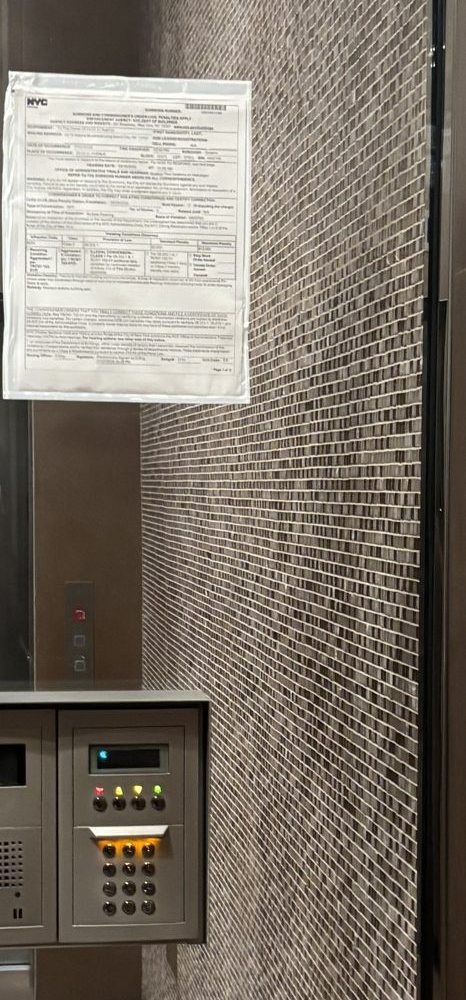
The notice lists two violations, both Class C, which is HPD’s most serious class (“immediately hazardous”). In the notice’s own words:
- “§ 27-2005 Adm Code: provide heavy duty key operated lockset at building vestibule door.”
- “§ 27-2005, 2007 Adm Code: remove the illegal fastening electro magnetic locking device at building vestibule door.”
It was reported on 14 July 2026, with a correct-by date of 23 July and a certify-by date of 30 July. That is nine days to do the work and seven more to certify it.
What We Found
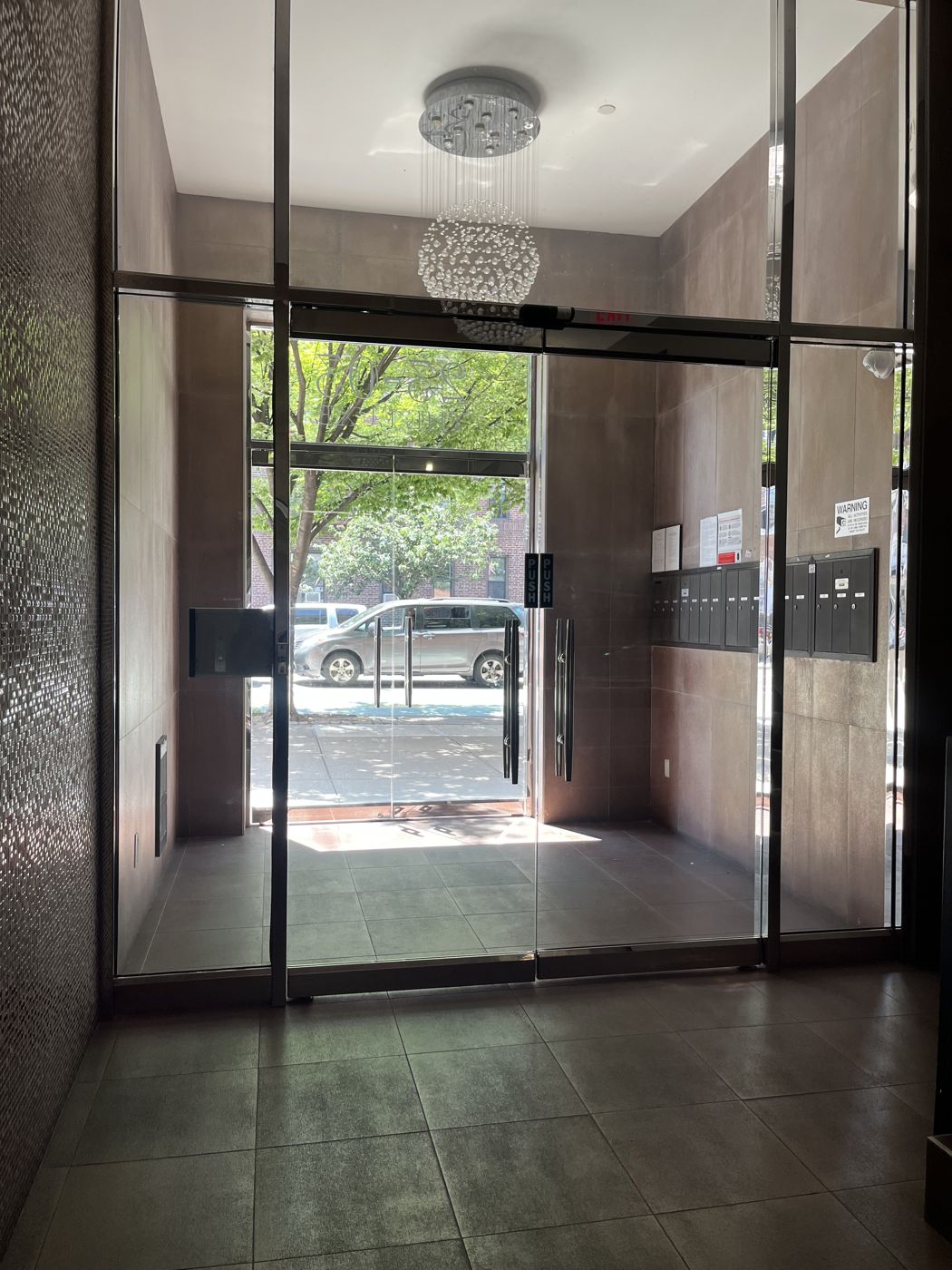
The vestibule is a handsome one: a pair of frameless all-glass doors with full-height pull handles, set in a glass surround with polished stainless steel trim, and an intercom panel on the wall beside it. The doors were held shut by an electromagnetic lock, a “maglock”: an electromagnet on the frame and a steel plate on the door, released by the intercom or a button.
Why a Magnetic Lock Is Written Up
A maglock is not a lock in the mechanical sense. Nothing latches. The door stays shut only while the magnet has power, and it opens only when an electrical device tells the magnet to let go. If the release button, the power supply or the wiring fails, people inside may not be able to get out by simply pushing the door. That is the concern behind the words “illegal fastening” in the notice: a building entrance has to open from the inside by hand, every time, with no power and no special knowledge.
The other half of the notice follows from the first. Take the magnet away and an all-glass door has nothing holding it closed, so HPD asks for a heavy-duty key-operated lockset. State law also requires the entrance doors of most apartment buildings to be self-closing and self-locking, with an intercom that lets a tenant release the door from the apartment (Multiple Dwelling Law § 50-a). So the door has to do four things at once:
- latch and lock mechanically, with a key from outside;
- open from inside by hand, with a push bar or a handle, at all times;
- release from each apartment through the intercom (the “buzzer”);
- close and lock again by itself.
How It Is Corrected
The compliant arrangement is a door with a mechanical latch, an electric strike in the frame that the intercom releases, a push bar on the inside so the door always opens mechanically, a key cylinder outside, and a closer. The latch does the holding; electricity only lets visitors in. If the power fails, the door stays locked from outside and still opens from inside.
On a framed aluminum door this is ordinary hardware. On a frameless glass door it is harder: there is no stile to take a latch or a strike, so the hardware has to be clamped to the glass or the door has to be changed. The two routes we look at are:
- Keep the glass doors and fit lock hardware made for all-glass doors, where the glass, its fittings and the frame allow it.
- Replace the door with an aluminum storefront door and frame that carries a push bar, a latch, an electric strike and a closer as standard. This is the route we recommend where the entrance takes heavy daily use, with a medium-stile door for a longer life.
The Problem With Nine Days
A lockset can sometimes be changed in a day. A new door cannot. It has to be surveyed, drawn, fabricated to the opening, glazed with safety glass and installed, and the electric strike has to be connected to the intercom. Realistically that is two to three weeks at the least. An owner who receives this notice should call a door company the same day, get the survey and a written proposal with a schedule straight away, and ask HPD or the managing agent what can be done about the dates while the work is in hand.
We set out the requirements, the cost of a replacement door and the ways to avoid the violation in the first place in HPD entrance door violations: requirements, cost and timeline.
Project Log
23 July 2026 — Site visit
Reviewed the HPD notice with the owner, photographed the doors, the magnetic lock and the intercom, and recorded what the entrance needs to satisfy both items.
Sources
- NYC HPD: Self-Closing Doors
- HPD guide for property owners: “Close the Door to Stop a Fire from Spreading” (PDF)
- New York Multiple Dwelling Law § 50-a
Related
HPD entrance door violations: requirements, cost, timeline · Building entrance doors · Storefront doors · Door design: stile, pulls, closers · All Office News
Received a Notice About Your Entrance Door?
Send us a photograph of the notice and of the door from inside and outside. We will tell you what it takes to correct it, how long, and what it costs.