Narrow, medium or wide stile; C-pulls, ladder pulls or offset ladder pulls; surface-mounted or concealed overhead closer. What each choice means for an aluminum entrance door.
Walk down any commercial street and almost every shop, office and lobby entrance is the same product: an aluminum and glass storefront door. The frames come from a handful of manufacturers and look alike at a glance, but three choices decide how the door looks, how long it lasts and what it costs: the stile width, the pull handle and the door closer. This article explains each one and says which design is the most popular.
The most popular commercial door design is a narrow- or medium-stile aluminum door, 3 feet wide by 7 feet high, with one large lite of tempered or insulated glass, a pull handle outside, a push bar inside, a deadlock at the meeting stile, and a closer. Narrow stile is the most common on small shops because it is the least expensive and shows the most glass. Medium stile is the one we recommend most often, because it stands up to daily traffic far better for a modest increase in cost. Wide stile is chosen for heavy use and for doors that carry panic hardware.
The national names are Kawneer, YKK AP and Tubelite, along with a few others. Each publishes the same family of three doors under its own numbers: Kawneer’s 190, 350 and 500; YKK AP’s 20D, 35D and 50D; Tubelite’s narrow, medium and wide stile. The numbers hint at the stile width. Because the products are so closely matched, architects’ specifications usually name one manufacturer and add "or equal".
That clause opens the door to regional manufacturers. Gamco, made in New York, is one example: less known nationally than the big three, but producing doors and framing to the same pattern and commonly accepted as an equal. For a building owner the practical differences between brands are lead time, local parts supply and price, not appearance. What matters far more than the name on the frame is choosing the right stile, hardware and closer for the entrance. See commercial aluminum and storefront doors for the systems we supply.
The stiles are the vertical members of the door leaf; the rails are the horizontal ones at top and bottom. "Narrow", "medium" and "wide" describe how wide those aluminum members are, and therefore how much metal surrounds the glass.
| Narrow stile | Medium stile | Wide stile | |
|---|---|---|---|
| Vertical stile, about | 2 inches | 3½ inches | 5 inches |
| Look | Most glass, lightest frame | Balanced | Heavy, solid frame |
| Strength | Adequate for light and moderate traffic | Strong; resists twisting | Strongest |
| Hardware it accepts | Pulls, push bars, narrow deadlocks, rim panic devices | Most locks and exit devices | Everything, including mortise locks and concealed rod devices |
| Typical use | Shops, small offices, interior vestibules | Busy retail, apartment lobbies, restaurants, offices | Schools, hospitals, transit, public buildings |
| Cost | Lowest | Moderate | Highest |
Narrow stile is the classic shopfront door. Its slim frame keeps the entrance looking open, and for a store with moderate foot traffic it performs well for years. Its weakness is stiffness: a tall, heavy narrow-stile door that is pushed hard hundreds of times a day will eventually sag or rack, and the slim stile leaves little room for hardware.
Medium stile adds about an inch and a half of aluminum to each side. That extra section makes the leaf much more rigid, gives the corner joints more to hold, and provides room for a wider range of locks and exit devices. It is the sensible default for an apartment building entrance, a restaurant or any door that works all day.
Wide stile is specified where abuse is expected or where the hardware demands it: schools, hospitals, stadiums and doors with full panic hardware, electric strikes or automatic operators.
The bottom rail is a separate decision. A standard bottom rail is a few inches high; a 10-inch bottom rail is common on accessible entrances, because it gives a smooth surface at the bottom of the push side that a wheelchair footrest can meet without catching. Many owners choose it on every entrance for that reason and because it protects the glass from carts and feet.
The handle is what people touch, and it is the cheapest way to change the character of a door. All of the types below are fixed pulls: they do not latch. The door is held shut by the closer and locked by a separate deadlock or exit device.
Standard push-pull set. The traditional storefront hardware: a short offset pull on the outside and a horizontal push bar across the inside. It tells people which way the door swings without a sign, it is inexpensive, and every manufacturer supplies it as standard.
C-pulls, back to back. A C-pull is a simple bar bent into a C shape, typically 8 to 12 inches between fixings. Mounted back to back, one pull sits on each face of the door and the pair is through-bolted to each other through the stile, so neither can be pulled off. It is compact, strong and neutral in style, and it works on narrow stiles. Use it where the door swings both ways or where a push bar is not wanted.
Ladder pulls. A ladder pull is a long vertical bar, from about 2 feet up to the full height of the door, carried on two or more standoff posts so that it resembles one side of a ladder. It can be gripped at any height, which suits children, wheelchair users and people carrying things, and it gives a pair of doors a strong vertical line. Ladder pulls are usually mounted back to back as well. They are the most requested handle on new residential and retail entrances at the moment, in black, stainless or bronze.
Offset ladder pulls. On a standard ladder pull the bar sits directly in front of its posts, over the stile. On an offset ladder pull the posts are angled or cranked so that the bar stands to one side, over the glass. That moves the hand clear of the frame, leaves the lock cylinder and any exit-device trim accessible between the fixings, and lets a thick bar be used on a narrow stile. It is the better choice when the pull is long and the stile is slim.
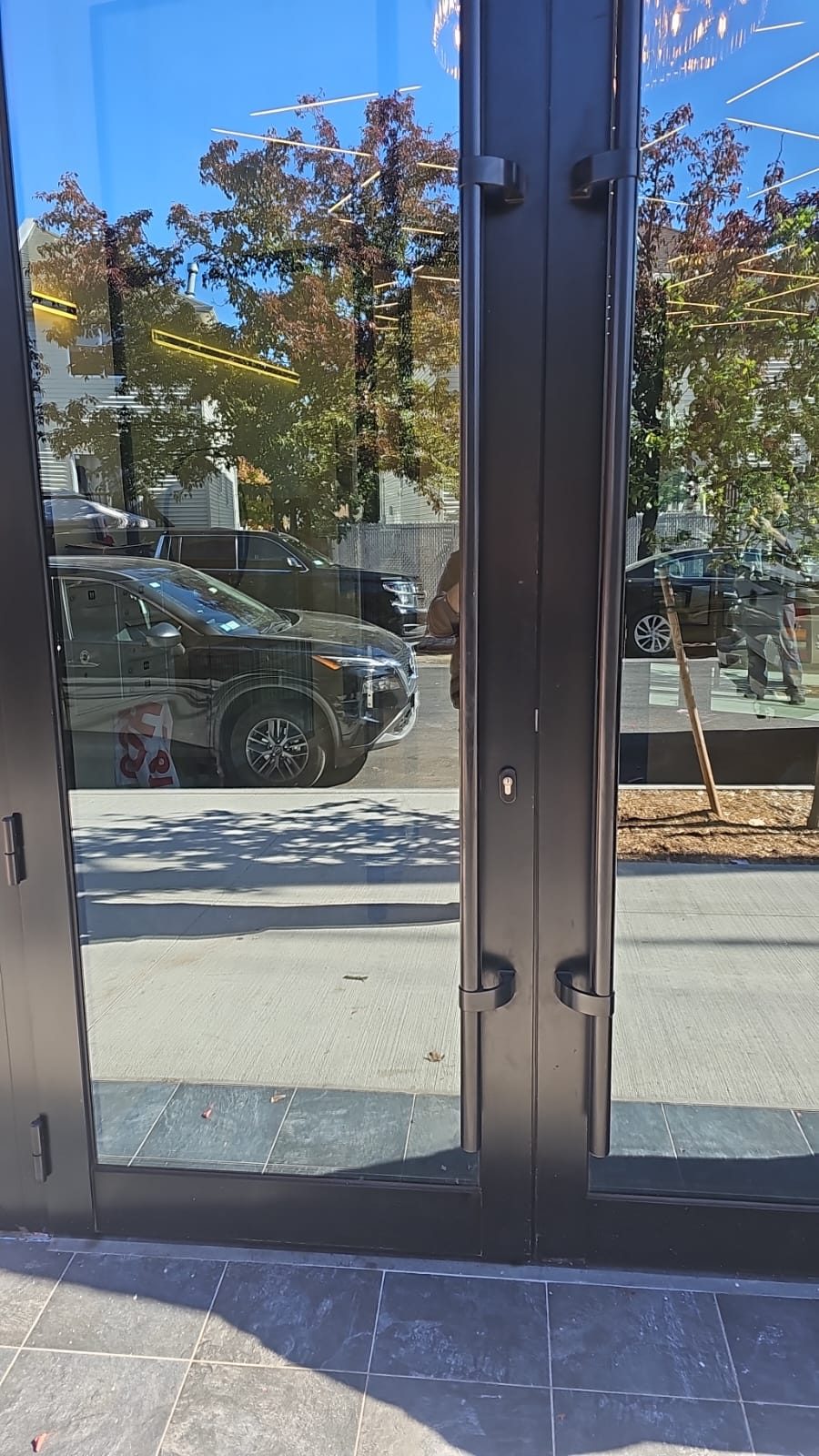
Whichever pull is chosen, it should be operable with one hand without tight grasping or twisting, and mounted at a height people can reach. The finish should match the door: see our note on matching handle shapes for the same principle applied to bathrooms.
Every storefront door needs a closer. It shuts the door behind each person, controls the speed so the door neither slams nor drifts, and stops it from being thrown open by the wind. There are two common types on aluminum doors.
Surface-mounted closer. The closer body is fixed to the face of the door or the frame at the top, with a visible arm linking the two. It is the most common closer in commercial buildings generally.
Concealed overhead closer (COC). The closer is hidden inside the aluminum header above the door, and the door hangs from it on a pivot. Nothing shows except a small arm or spindle at the top of the door. This is the traditional closer for storefront entrances and the reason so many shop doors appear to have no closer at all.
| Surface-mounted | Concealed overhead (COC) | |
|---|---|---|
| Appearance | Visible body and arm | Hidden in the header |
| Service | Simple | More involved |
| Heavy or oversized doors | Good | Limited |
| Double-acting doors | No | Yes, center-hung |
| Cost | Lower | Higher |
| Most common on | Offices, institutions, back-of-house | Retail and lobby storefront entrances |
Accessibility rules also apply to closers: an accessible door must not close too fast, and interior doors have a limit on the force needed to open them. A closer with adjustable closing and latching speed, set properly at installation and checked each season, is what keeps a door compliant and prevents the slow drift into slamming. For how the door is hung, see continuous hinges versus standard hinges.
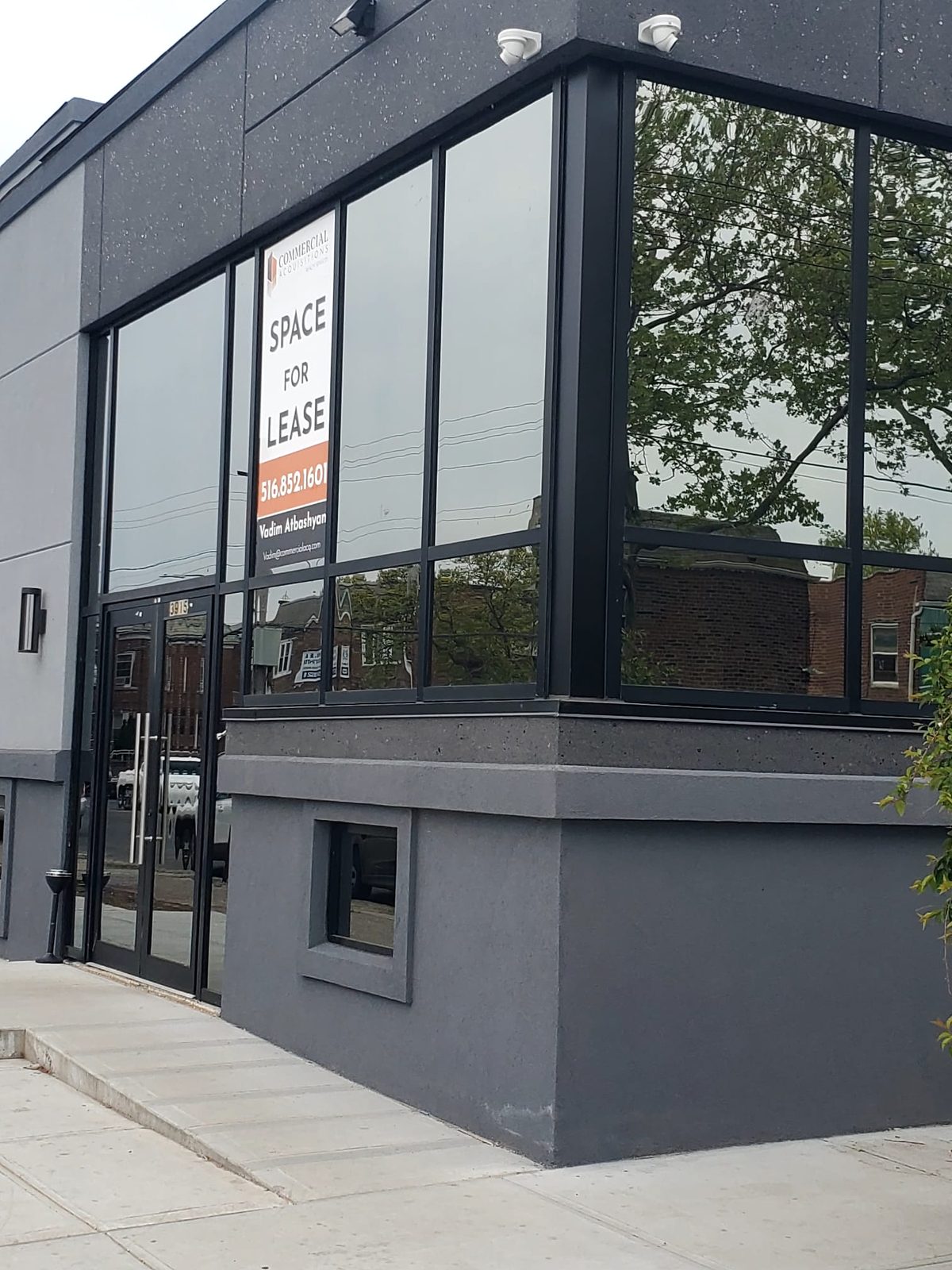
In every case the glass is tempered safety glass, and on an exterior entrance in New York it should be an insulated low-E unit in a thermally broken door if the energy code applies to the work. Recent examples of ours: 3915 Flatlands Avenue, 1209 Vine Street, Philadelphia and 2461 Flatbush Avenue.
A narrow- or medium-stile aluminum storefront door, 3 by 7 feet, with one large glass lite, a pull outside and push bar inside, a deadlock and a closer. Narrow stile is most common on small shops; medium stile is the better all-round choice.
The width of the vertical aluminum members: about 2 inches, 3½ inches and 5 inches. Wider stiles make the door stronger and accept more hardware, at higher cost and with less glass.
They are equivalent products built to the same pattern, and specifications usually accept one as equal to another. Regional manufacturers such as Gamco make comparable doors.
A long vertical pull whose bar stands to one side of its mounting posts, over the glass, so the hand clears the frame and the lock stays accessible between the fixings.
One pull on each face of the door, through-bolted to each other through the stile so neither can be pulled off.
It looks cleaner and suits storefront entrances, but it is harder to service and has limits on door size and weight. Surface closers are simpler, stronger and cheaper.
A concealed overhead closer: a door closer hidden inside the frame header above the door.
Storefront Doors Commercial Doors Building Entrance Doors Continuous Hinge vs Standard Hinges Storefront Repair Storefront Replacement in Brooklyn All News
About this page. Written by Alex GC Inc. d/b/a Alex Glass Construction and reviewed before publication by Aleksandr Chernovolenko, Managing Partner, with our design and estimating lead and a field foreman. Our foremen hold the NYC DOB Site Safety Training supervisor card and our crews the 40-hour worker card; we are certified to fabricate, install and service Alutech and Everest aluminum systems. Facts are drawn from our own projects, manufacturer test data and the applicable codes; where we are giving an opinion, we say so. Last reviewed September 2026. Credentials
Send the opening size, a photo of the entrance and how busy the door is. We will recommend the stile, pulls and closer, and quote it.