What actually changes when a Brooklyn shop, office or restaurant replaces its front: what you gain on day one, what you gain over ten years, and what the work involves.
Most storefronts on Brooklyn’s commercial avenues were installed decades ago: single glazing or early insulated glass, bronze or mill-finish aluminum frames, a door that has been re-hung more than once. They still keep the rain out. But a storefront does several jobs at once — it is the sign, the window display, the front door, the security line and a large part of the heating bill — and an old one does most of them badly. This article sets out, plainly, what a storefront replacement in Brooklyn gives a business, and what the work involves.
We wrote separately about why owners replace a storefront that still works. This piece is the practical companion: benefits, outcomes and process.
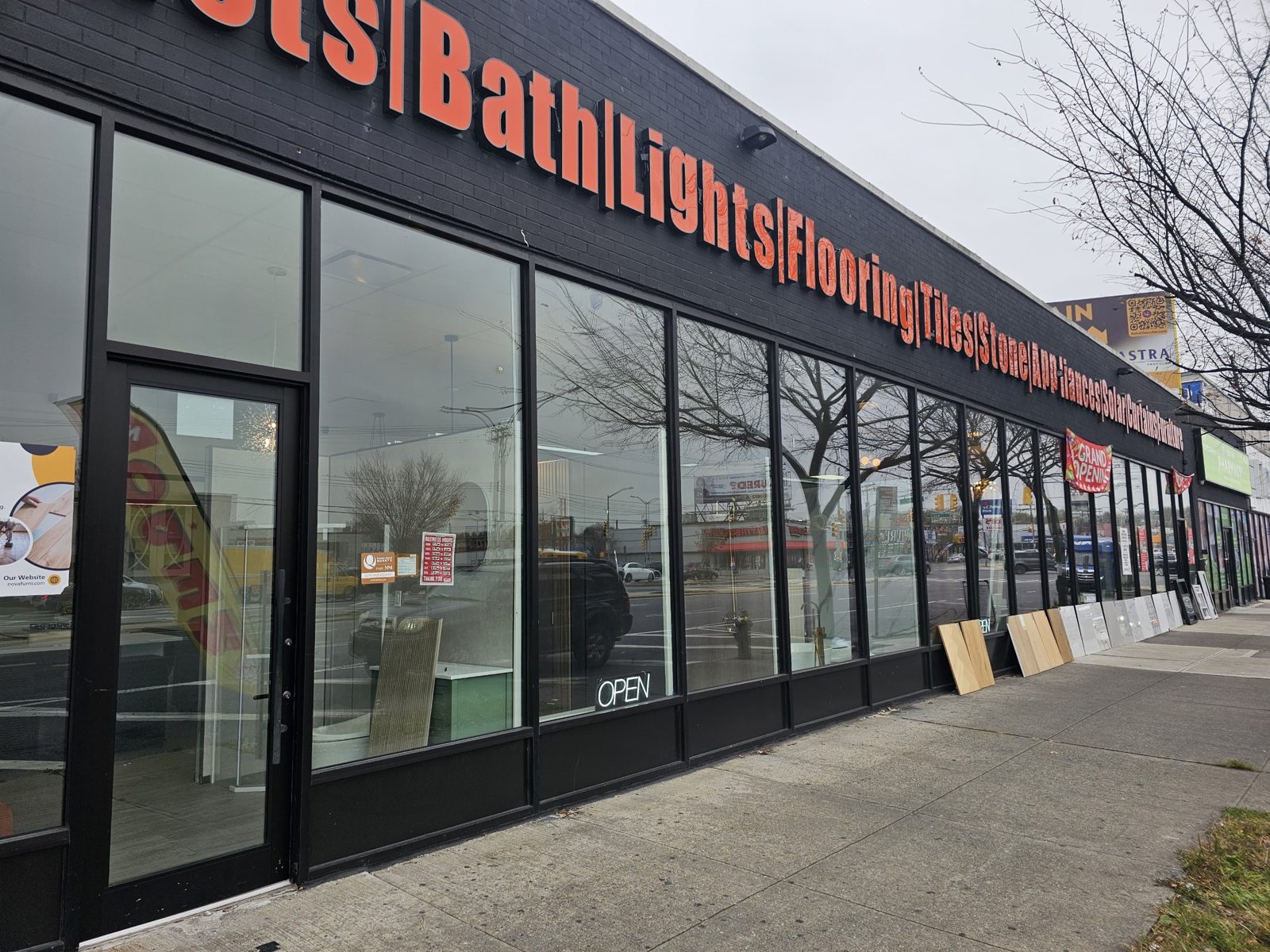
The shop can be seen into. Old tinted or hazed glass reflects the street and hides the interior. New clear low-E glass lets people on the sidewalk see the product, the tables or the reception desk. For a retail business this is the single biggest change: the display works again.
A wider, cleaner opening. Modern aluminum storefront systems carry larger lites on narrower frames than the systems of thirty or forty years ago. Replacing a front often removes intermediate mullions and old infill panels, so the same masonry opening shows more glass.
A door that works. A new storefront door on new pivots or a continuous hinge, with a closer set for the weight, closes and latches by itself. No sticking, no slamming, no draught strip of daylight at the threshold.
A front that matches the business. Frame colour, door pulls, signage band and lighting can all be chosen for the brand you have now, not the tenant from 1995. Black and dark bronze anodized or painted frames are the most requested in Brooklyn at the moment; clear anodized remains the most economical.
Lower heating and cooling cost. A storefront is mostly glass, and a street-level shop has a lot of it. Going from single glass or failed insulated units to insulated low-E glass in thermally broken frames reduces heat loss in winter and solar gain in summer. How much depends on the building, but the front is usually the largest single surface in a small shop, so it is where an improvement shows.
Comfort near the window. The seats by the glass in a café, the cashier by the door, the first rack of clothing: with warm-edge insulated glass these stop being the cold zone in January, and condensation on the inside of the glass largely goes away.
Better security. Laminated glass holds together when struck, which slows a break-in and keeps the opening closed after an impact. New doors take proper locks, and the frames accept rolling grilles or gates behind the glass instead of a solid shutter in front of it, so the display stays visible at night.
Easier access. Replacing the entrance is the moment to correct a door that is too narrow, a threshold that is too high, or hardware that is hard to operate. A level threshold and a door with the right clear width help customers with strollers, deliveries and wheelchair users alike. Your architect will confirm what the accessibility rules require for your space.
Less maintenance. New gaskets, new sealant joints and a properly flashed sill stop the slow leaks that rot the floor behind old fronts. Finishes on current aluminum systems are far more durable than old paint.
A stronger lease position. For a landlord a new front makes a vacant unit easier to let; for a tenant it is an improvement worth raising when the lease is renewed. Either way it is one of the few upgrades every passer-by sees.
If the frames are sound and only the glass or the door has failed, storefront repair may be the better answer. We will say so when it is.
Most of the time is fabrication, during which the shop trades normally. Work on site for a typical single shop front is a matter of days. Landmark approval or a building department filing, where needed, adds time before fabrication starts.
Usually yes, with some disruption on the installation days. The work is sequenced so the opening is secured at the end of each day.
Better visibility into the shop, lower heating and cooling cost, improved security with laminated glass, an entrance that is easier to use, and less maintenance.
It depends on the scope and on whether the building is in a historic district, where Landmarks Preservation Commission approval is required. Ask your architect or expediter before ordering.
If the frames are straight and sound and only glass, gaskets or the door have failed, repair is often enough. If the frames are corroded, leaking or single-glazed, replacement is usually the better investment.
Storefront Doors Storefront Repair Storefront vs Curtain Wall Commercial Doors Brooklyn Windows, Doors & Glass Stainless-Clad Storefront Doors All News
About this page. Written by Alex GC Inc. d/b/a Alex Glass Construction and reviewed before publication by Aleksandr Chernovolenko, Managing Partner, with our design and estimating lead and a field foreman. Our foremen hold the NYC DOB Site Safety Training supervisor card and our crews the 40-hour worker card; we are certified to fabricate, install and service Alutech and Everest aluminum systems. Facts are drawn from our own projects, manufacturer test data and the applicable codes; where we are giving an opinion, we say so. Last reviewed September 2026. Credentials
Send a photo of the front and the approximate width and height. We will tell you whether it needs repair or replacement and quote it.