Panic hardware is chosen by code; the door it goes on is chosen by the hardware. Here is which exit devices each stile width can carry, why a narrow stile cannot take a mortise device, and how we specify the door so the device, trim and closer all land in metal.
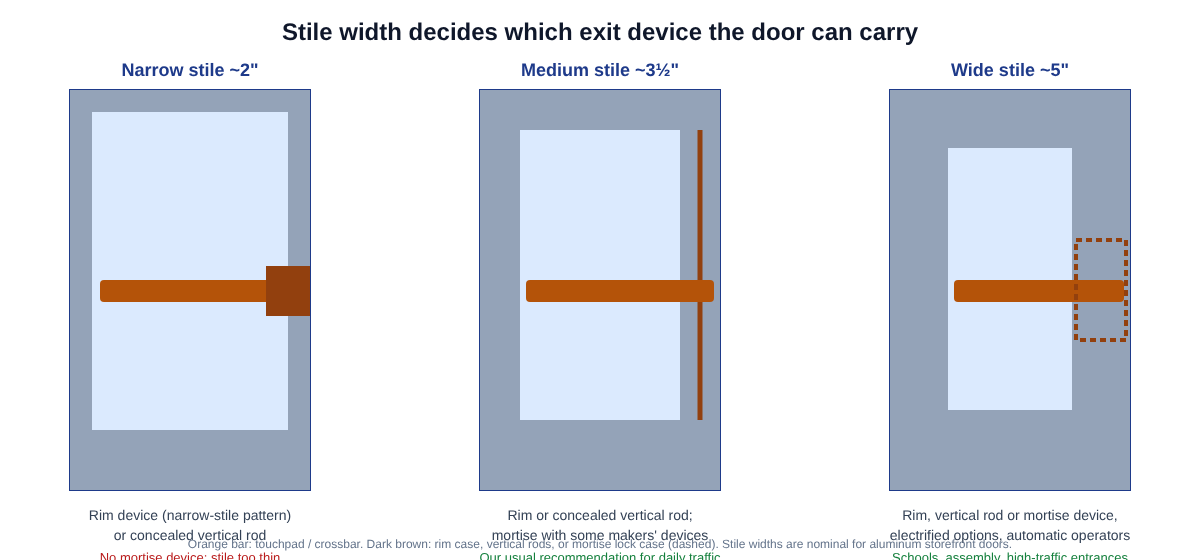
In short: The stile is the vertical frame member of an aluminum glass door, and its width decides which exit device (panic bar) the door can carry. A narrow stile (about 2") takes a rim device made in a narrow-stile pattern or a concealed vertical rod device; it is too thin for a mortise exit device. A medium stile (about 3½") takes rim and concealed vertical rod devices and, with some manufacturers, a mortise device. A wide stile (about 5") takes any type, including mortise, electrified latch retraction and the heavier hardware specified for schools, assembly spaces and high-traffic entrances. Whether the door needs an exit device at all is set by the occupancy and the occupant load under the NYC Building Code, not by the door.
Panic hardware is required, not optional, on doors serving certain spaces. Under the NYC Building Code (which follows the International Building Code on this point) a door that is part of the means of egress must have panic or fire exit hardware when it serves an assembly occupancy or an educational occupancy with an occupant load of 50 or more, or a high-hazard occupancy, and in a few other cases such as certain electrical rooms. The hardware must open the door with a single motion, with no key, tool or special knowledge, and the force to release it is limited to 15 pounds.
A small retail store with an occupant load under 50 does not need one; a restaurant, bar, gym, place of worship or school usually does. The architect of record or the expediter makes that call on the drawings. What we do is make sure the door that is ordered can carry the device that is specified, which is where stile width comes in. For the stile widths themselves and what else they affect, see storefront door design: stile width, pulls and closers.
| Type | How it latches | Where it mounts on the door | Minimum stile it needs |
|---|---|---|---|
| Rim | A latch bolt in a case on the inside face of the door catches a strike on the frame (or on a mullion) | Surface-mounted on the stile, across the door at push height | Narrow stile, in a narrow-stile pattern device; standard rim devices need medium or wide |
| Concealed vertical rod (CVR) | Rods inside the stile throw bolts into the head and the threshold | Rods hidden in the lock stile; only the touchpad shows | Narrow stile and up; the device is made for the stile section |
| Surface vertical rod (SVR) | Same as CVR but the rods run on the face of the door | Rods exposed on the inside face | Any width, but rarely used on glass doors because of the look |
| Mortise | A mortise lock body set into the stile, latching to a frame strike | Lock body inside the stile; touchpad on the face | Wide stile; medium stile only with devices made for it |
For a pair of doors there is one more decision: a removable mullion between the leaves lets both carry a rim device; without a mullion the leaves need vertical rod devices (or one rod device and one rim device latching into it). On a glass storefront pair the clean answer is usually CVR on both leaves, which is why CVR is so common on narrow stile pairs.
A narrow stile of about 2" leaves little metal around the glass. It carries a rim device only if the device is a narrow-stile pattern, with a case shallow enough to sit on the stile and a latch that projects far enough to reach the frame strike; several manufacturers make these specifically for aluminum glass doors. It carries a concealed vertical rod device because the rods run inside the stile cavity and need no lock pocket. It cannot carry a mortise device: there is no room for the lock body, and cutting the pocket would weaken the corner joint.
The limitation that catches people is not the device but the trim. A narrow stile is also too thin for most lever trims on the outside, so a narrow-stile door with an exit device is typically entered with a pull and a cylinder dogging or an outside key cylinder, not a lever. If the owner wants a lever outside, the door should be medium or wide stile.
At about 3½" the medium stile accepts standard rim devices without the narrow-stile pattern, concealed vertical rods, and outside lever trims. Some manufacturers rate their mortise exit devices for medium stile doors; others require wide stile. We check the device's template against the door section before ordering, because the mortise pocket, the cylinder hole and the trim all have to land in the metal, not in the glass stop. For daily retail and office traffic this is the stile we recommend, with a rim or CVR device where panic hardware is required.
A 5" wide stile carries any exit device, including mortise devices, electrified latch retraction for access control, request-to-exit switches, alarm devices and the heavy-duty closers and automatic operators that go with them. It is specified for schools, clinics, stadiums, transit and anywhere the door is abused; the stile also keeps the leaf rigid, so the latch and strike stay aligned over years of slamming. The cost is appearance, with less glass and a heavier frame, and weight, which the closer and the pivots have to be sized for.
On a new storefront we take the hardware set from the architect's schedule, confirm the occupancy requirement with the expediter if the schedule is silent, and choose the stile width to suit the device rather than the other way round. The door manufacturer preps the stile for the device at the factory from the hardware template, so the device, the trim, the cylinder and the closer are all decided before the door is ordered. On a replacement device we photograph the old device, measure the stile and the backset, and match. For the doors themselves see storefront doors and commercial doors.
Yes, with a rim exit device made in a narrow-stile pattern or a concealed vertical rod device. It cannot take a mortise exit device or most outside lever trims.
A rim device has its latch in a case on the face of the door and catches a strike on the frame; a mortise device has a lock body set into the stile. Rim devices fit narrower stiles; mortise devices need a wide stile.
A device whose rods run inside the door stile and throw bolts into the head and the threshold, so only the touchpad is visible. It fits narrow, medium and wide stiles and is the usual choice for pairs of glass doors without a mullion.
On egress doors serving assembly or educational occupancies with an occupant load of 50 or more, high-hazard occupancies and certain other rooms, under the NYC Building Code. The architect confirms the requirement for the project.
Medium stile for most retail and office doors with a rim or CVR device; wide stile for schools, assembly, electrified hardware, automatic operators or heavy abuse; narrow stile only when the look matters most and a narrow-stile rim or CVR device is acceptable.
Yes, matching the type and stile pattern of the old device. Changing the type, for example rim to mortise on a narrow door, usually means a new door.
The release force on the device is limited to 15 pounds; the touchpad must be between 34 and 48 inches above the floor.
Storefront door design: stile width, pulls and closers Storefront doors Commercial doors Storefront glass replacement NYC Storefront repair Finger protection on storefront doors
About this page. Written by Alex GC Inc. d/b/a Alex Glass Construction and reviewed before publication by Aleksandr Chernovolenko, Managing Partner, with our design and estimating lead and a field foreman. Our foremen hold the NYC DOB Site Safety Training supervisor card and our crews the 40-hour worker card; we are certified to fabricate, install and service Alutech and Everest aluminum systems. Facts are drawn from our own projects, manufacturer test data and the applicable codes; where we are giving an opinion, we say so. Last reviewed November 2026. Credentials
Send a photo of the door and the device, or the hardware schedule. We will confirm which device the stile can carry and quote the door or the replacement.