How a full-height hinge and a finger guard close the dangerous gap on the hinge side of an aluminum door, with our doors at 2555 Nostrand Avenue as the example.
Most people think of the latch side of a door as the dangerous one. The serious injuries happen on the other side, at the hinges. An aluminum storefront door is heavy, it is closed by a spring-loaded closer, and the gap at its hinge edge opens wide enough for a small hand and then shuts with great force. In any building that children visit, that gap deserves a decision, not an afterthought. This article explains the two parts we use to close it, a continuous hinge and a finger guard, using the doors we installed at 2555 Nostrand Avenue in Midwood, Brooklyn as the example.
When a door swings open, a gap opens between the hinge edge of the door and the frame. On the side the door opens toward, it can be an inch or more wide. As the door closes, that gap narrows to almost nothing, and the door acts as a lever: a light push at the handle becomes a very large force at the hinge.
Adults rarely put a hand there. Children do. They lean on the frame, follow a parent through, or hold the door edge while someone else lets it go. The person closing the door usually cannot see the hinge side at all.
There are two gaps to deal with: the one between the hinges on the edge of the door, and the wider one on the face of the door, on the side it opens toward. One product does not cover both, which is why we fit two.
A standard storefront door hangs on three or four separate butt hinges, or on pivots at the top and bottom. Between them, the hinge edge is open.
A continuous hinge, also called a piano hinge, runs the full height of the door in one piece. On aluminum entrance doors it is normally a geared type: two long aluminum leaves that mesh along their length under a cover. It does three useful things:
We compare the two approaches in detail in continuous hinge vs standard hinges on a storefront door.
The continuous hinge deals with the edge. The finger guard deals with the face: the wide, V-shaped gap on the side the door opens toward.
A finger guard is a flexible pleated strip the full height of the door. One side is fixed to the frame and the other to the door. It fans out as the door opens and folds flat as it closes, so the gap is covered at every point of the swing and a hand has nowhere to go.
Guards are made in colors to match the frame, they do not change how the door swings, and they can be added to a door that is already in service.
At 2555 Nostrand Avenue we supplied and installed two black anodized, wide-stile aluminum doors in a commercial fit-out. The building is used by families, and children are around the place every day, so the doors were specified with safety first:
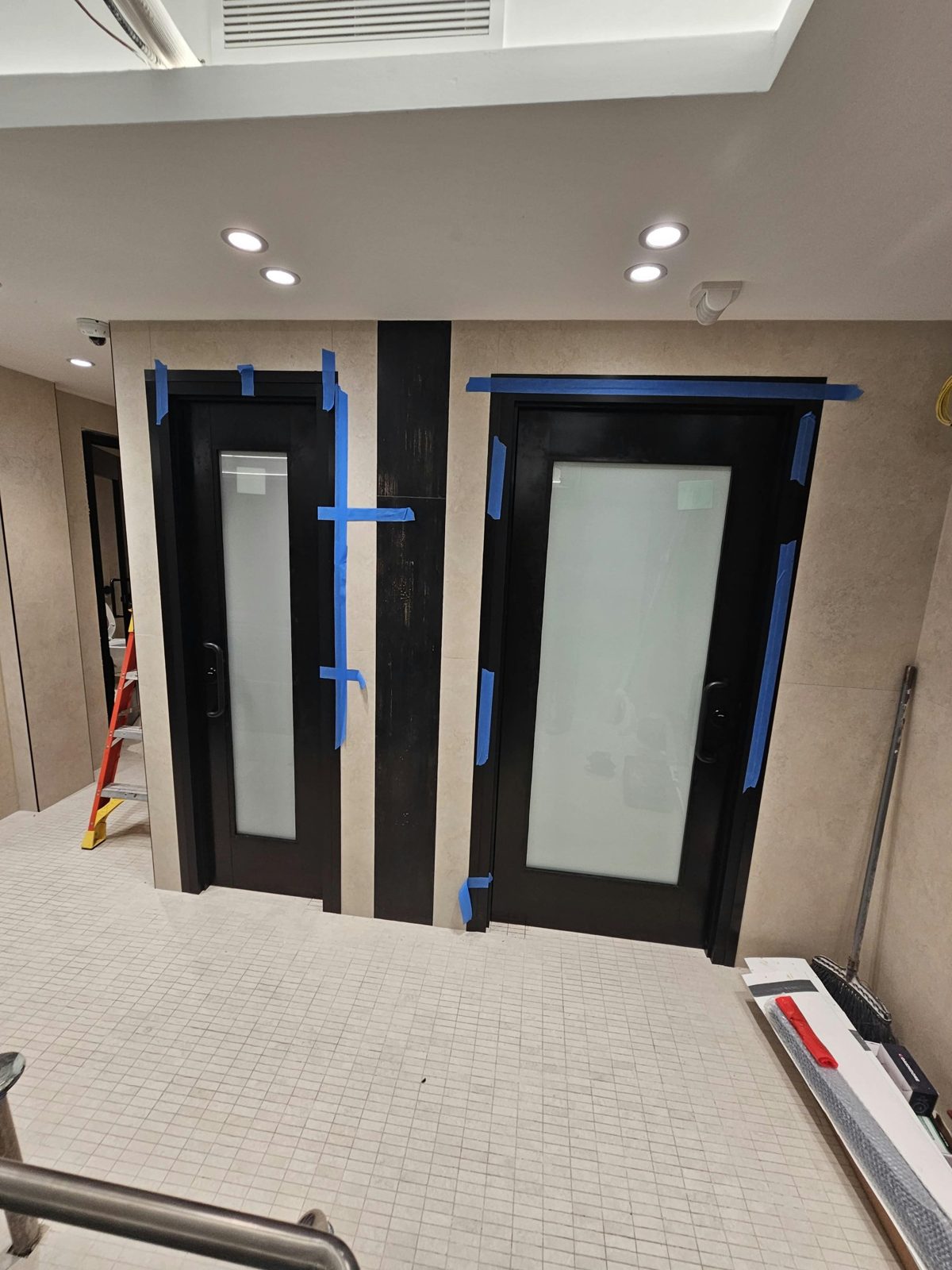
The full description and photographs are on the project page.
The hinge side is the main risk, but not the only one.
We recommend it wherever children or vulnerable people use a door without close supervision:
Whether it is required depends on the type of facility and on the authority or insurer that oversees it, so check the rules that apply to yours. Where it is not required, it is still one of the least expensive safety improvements on a door.
On a new door, ask for the continuous hinge at the order stage: the door and frame are prepared for it in the shop. The finger guard goes on after the door is hung and adjusted.
On an existing door, a finger guard can usually be fitted in a short visit. Changing butt hinges or pivots to a continuous hinge is also possible on many aluminum doors, and is often done when a door has started to sag. We check the door, frame and closer first, because a guard should go on a door that already swings and closes correctly. See storefront doors and commercial doors.
A flexible pleated strip the full height of a door that covers the gap between the door and the frame on the hinge side. It fans out as the door opens and folds flat as it closes, so fingers cannot enter the gap.
It closes the hinge edge of the door from top to bottom, so there is no open space between separate hinges. The wider gap on the face of the door still needs a finger guard, which is why the two are used together.
Yes. A guard can usually be fitted to a door already in service, provided the door swings and closes correctly. It comes in colors to match the frame.
Laminated glass is two lites bonded to an interlayer. If it breaks, the pieces stay attached and the glass remains in the door.
Wherever children use doors: daycare centers, schools, pediatric and medical offices, restaurants, shops, community buildings and residential entrances.
Project: 2555 Nostrand Avenue Continuous Hinge vs Standard Hinges Commercial Door Design Storefront Doors Commercial Doors Laminated Glass All News
About this page. Written by Alex GC Inc. d/b/a Alex Glass Construction and reviewed before publication by Aleksandr Chernovolenko, Managing Partner, with our design and estimating lead and a field foreman. Our foremen hold the NYC DOB Site Safety Training supervisor card and our crews the 40-hour worker card; we are certified to fabricate, install and service Alutech and Everest aluminum systems. Facts are drawn from our own projects, manufacturer test data and the applicable codes; where we are giving an opinion, we say so. Last reviewed September 2026. Credentials
Send a photograph of the door and its hinge side. We will tell you whether a finger guard, a continuous hinge or both will suit it.