A bar-type window guard does not fit a European window, so the limiter is how it complies. What the device is, why the stamp matters, the Health Code and Building Code rules that both apply on new construction, the six ways projects fail the inspection, and the key-released limiter that gives management full opening for cleaning.
In short: A window limiting device (limiter, restrictor, opening control device) is a small stainless steel arm or stop fitted inside the window frame that keeps the sash from opening more than 4 1/2 inches, the maximum the New York City Health Code allows in an apartment where a child ten or younger lives. On European tilt-turn and casement windows a bar-type window guard will not fit, so the limiter is the way those windows comply, and only limiters that carry a Department of Health and Mental Hygiene (DOHMH) approval, stamped on the device, are accepted. For new construction the limiter is inspected before the building gets its certificate of occupancy, and a missing, unapproved or wrongly set limiter is a violation with a per-window fine and a hold on sign-off. The right product also solves a second problem: a key-released limiter lets building staff open the window fully for cleaning and maintenance while residents cannot. We supply and install DOH-approved limiters on the Reynaers, Cortizo, Alutech, Kleidco and other European windows we install, and retrofit them on existing ones.
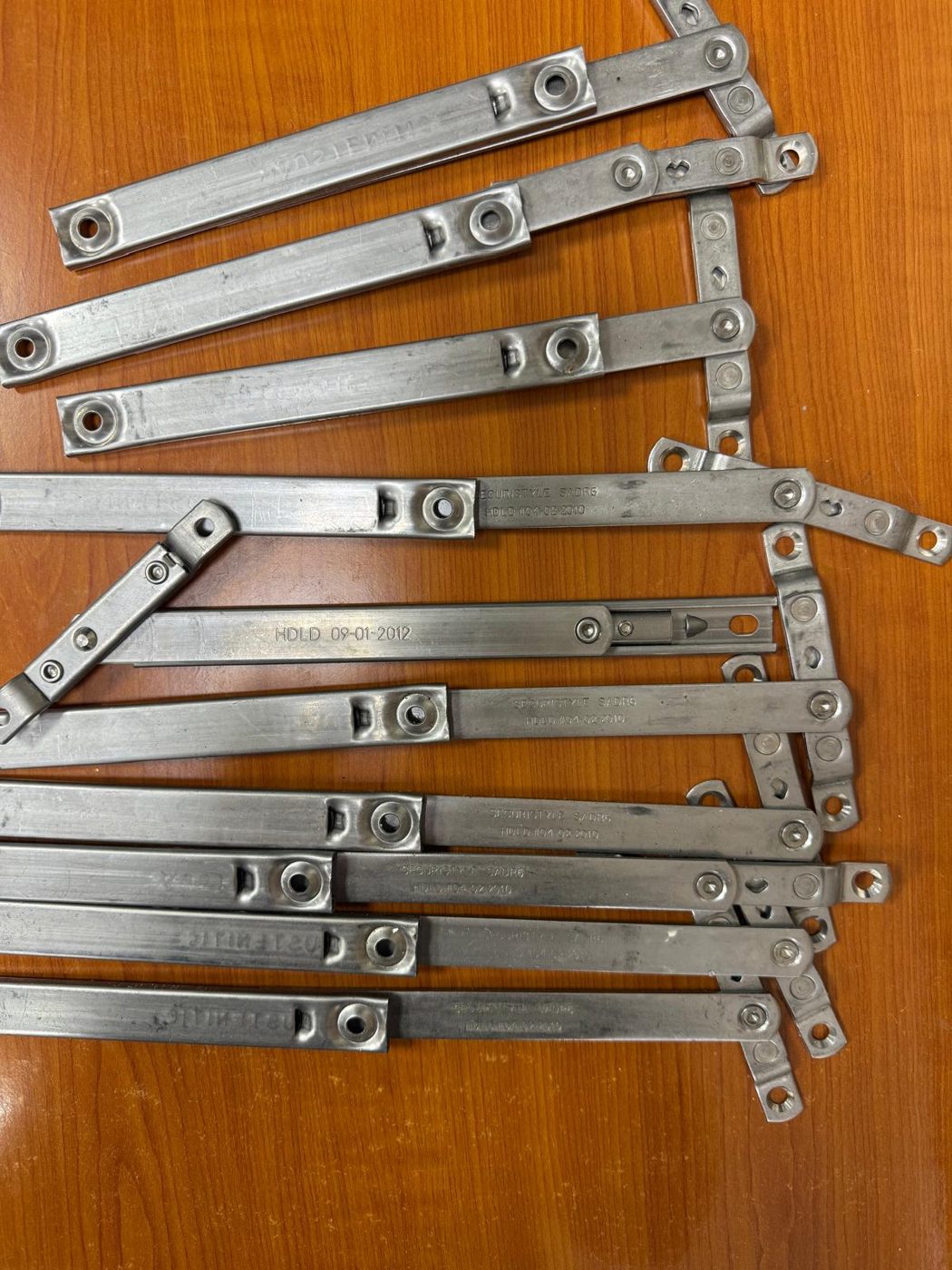
The limiter in the photograph is a stainless steel restrictor arm: one end rides in the frame, the other is fixed to the sash, and a stop in the slot halts the sash at the set opening. It is fitted inside the frame rebate, so it is invisible when the window is closed and does not change how the window looks from the street. Other approved forms are a fixed stop in the tilt-turn gear that limits the turn opening, and a keyed cable restrictor. All of them do the same thing: a child cannot push the sash past 4 1/2 inches, and an adult cannot open it further without a key or a tool.
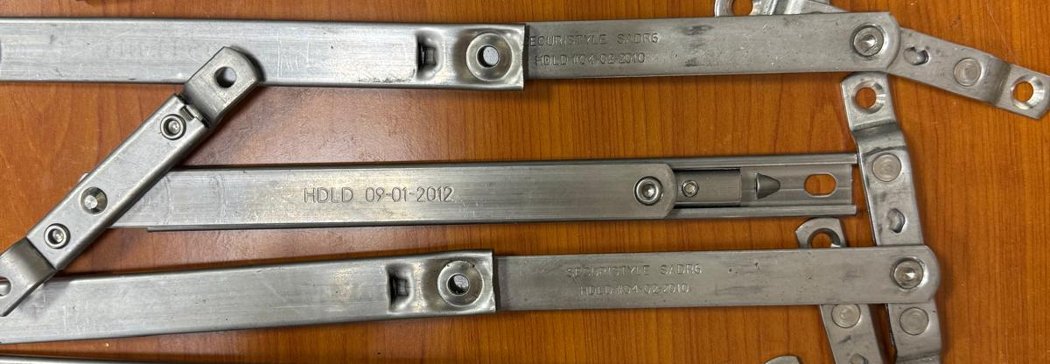
The stamp matters more than the metal. DOHMH keeps a list of approved window guards and limiting devices, and an approved device is marked with the manufacturer's name and the approval reference. An inspector does not test the device; they read the stamp and measure the opening. See the glossary entry and our window guard law page for the law itself.
| Health Code (occupied multiple dwellings) | Building Code (new construction and alterations) | |
|---|---|---|
| Who enforces | NYC Department of Health and Mental Hygiene, Window Falls Prevention Program | NYC Department of Buildings, at inspection and sign-off |
| When it applies | Any building with three or more apartments; required in units where a child 10 or under lives, on tenant request, and in public areas | R-2 and R-3 residential buildings: windows with the sill lower than 36 inches above the floor and more than 72 inches above grade |
| The opening limit | 4 1/2 inches, with a DOHMH-approved guard or limiting device | A 4-inch sphere must not pass, or a window opening control device per ASTM F2090 is fitted |
| Exceptions | Windows onto a fire escape, and the one window per room required for emergency egress where a fire escape is the exit | Fire escape windows and required emergency escape openings follow their own rules; confirm with the architect |
| What goes wrong | Unapproved device, device removable without a tool or key, opening set wider than 4 1/2 inches, no annual tenant notice | Device not on the approved submittal, wrong opening, device defeated by the handle, not fitted on every window that needs it |
A new residential building has to satisfy both. The Building Code is what the DOB inspector checks on the way to the certificate of occupancy; the Health Code is what governs the building for the rest of its life. The practical rule is to fit a limiter that is both DOHMH-approved and compatible with the Building Code opening limit on every window that meets the height test, from day one, and to document it. Fire-escape windows and designated egress windows are the exception and must be identified on the drawings before the order, not discovered by the inspector. Your expediter or architect confirms the list; we fit to it.
Each of these is a violation and a delay. In an occupied building the DOHMH issues a notice with a correction deadline and a civil penalty per window, and an unresolved window guard order can stop an owner from collecting rent on the unit; on new construction a failed inspection holds the sign-off until every window is re-inspected. The cost of the limiter is small; the cost of a second inspection round on a 60-unit building is not.
The complaint about limiters is practical: a window that opens 4 1/2 inches cannot be cleaned from inside, cannot be opened wide on a hot day for a vacant apartment, and gets in the way of maintenance. The answer is a key-released limiter. The restrictor has a lock cylinder or a keyed release; the superintendent's key frees the sash to open fully for cleaning, glazing repair or a move-in, and the arm re-engages automatically when the sash is closed. Residents have no key, so the window is restricted whenever they use it.
For emergency escape windows the rules are different: a device on a required egress window must be releasable from inside without a key or tool, which is what the ASTM F2090 opening control device does. Those windows are identified on the drawings and get that device; the rest of the apartment gets the keyed limiter.
To price limiters for a new building or a retrofit, send the window schedule or a count of windows by type, the system if it is a European tilt-turn or casement, and whether you want keyed release for management. request a quote and we will quote supply and installation, keyed alike, with the approval documentation.
A stop or restrictor fitted inside the window frame that keeps the sash from opening more than 4 1/2 inches. It is the approved alternative to a bar-type window guard on windows where a guard cannot be fitted, such as tilt-turn and casement windows.
Yes. In New York City only guards and limiting devices on the Department of Health and Mental Hygiene approved list, marked with the manufacturer and approval reference, satisfy the Health Code. An inspector reads the stamp.
They need a limiting device, because a standard bar guard does not fit the frame. The limiter restricts the turn opening to 4 1/2 inches; the tilt position must also be within the limit or controlled by a locking handle.
In R-2 and R-3 buildings, windows with a sill below 36 inches above the floor and more than 72 inches above grade must not pass a 4-inch sphere or must have a window opening control device per ASTM F2090. This is checked before the certificate of occupancy.
DOHMH issues a violation with a correction deadline and a civil penalty per window, and an open window guard order can affect an owner's ability to collect rent. On new construction a failed inspection holds the sign-off.
Yes, with a key-released limiter: the superintendent's key frees the sash for cleaning or maintenance and the device re-engages when the window is closed. Residents have no key.
Windows onto a fire escape and the designated emergency escape window must stay openable; a device there must release from inside without a key or tool. These windows are identified on the drawings and treated separately.
Yes. Approved limiters are retrofitted sash by sash on existing tilt-turn and casement windows, usually in one visit per line of apartments.
The owner, to every tenant, each January, asking whether a child ten or younger lives in the unit; the responses decide where guards or limiters must be installed or checked.
NYC window guard law Tilt-turn windows Casement windows Window hardware Aluminum windows for multifamily new construction HPD entrance door violations Glossary: window limiting device
About this page. Written by Alex GC Inc. d/b/a Alex Glass Construction and reviewed before publication by Aleksandr Chernovolenko, Managing Partner, with our design and estimating lead and a field foreman. Our foremen hold the NYC DOB Site Safety Training supervisor card and our crews the 40-hour worker card; we are certified to fabricate, install and service Alutech and Everest aluminum systems. Facts are drawn from our own projects, manufacturer test data and the applicable codes; where we are giving an opinion, we say so. Last reviewed November 2026. Credentials
Send the window schedule or a count by type and the system. We quote DOH-approved limiters, keyed alike for management, with the approval documentation for the inspector.