A good membrane that is not fully stuck to the wall holds water behind it, and nobody sees it until there is mold. What went wrong in one window opening, and how to check yours.
The short version. There is no such thing as a good or a bad waterproofing product on its own. Any product can be made bad by the way it is put on. Some products do more and some are more limited, but a self-adhered membrane that is not fully stuck to the wall will hold water behind it, and nobody will see it until there is mold.
Owners and contractors often ask us which waterproofing is “the good one”. It is the wrong question. A membrane, a tape or a sealant is only a material. It becomes waterproofing when it is installed the way it was designed to be: on the right surface, in the right conditions, with the right preparation.
Products do differ. Some bond to more kinds of surface, some can be applied in colder weather, some stretch further or last longer in the sun. Those are technical options, and they matter when choosing. But the best product on the shelf, put on badly, performs worse than a modest product put on properly.
The photograph below shows a window opening we were called to. The blue material is Blueskin, a self-adhered air and water barrier made by Henry. It is a good, widely used product. Here it is failing, and the product is not the reason.
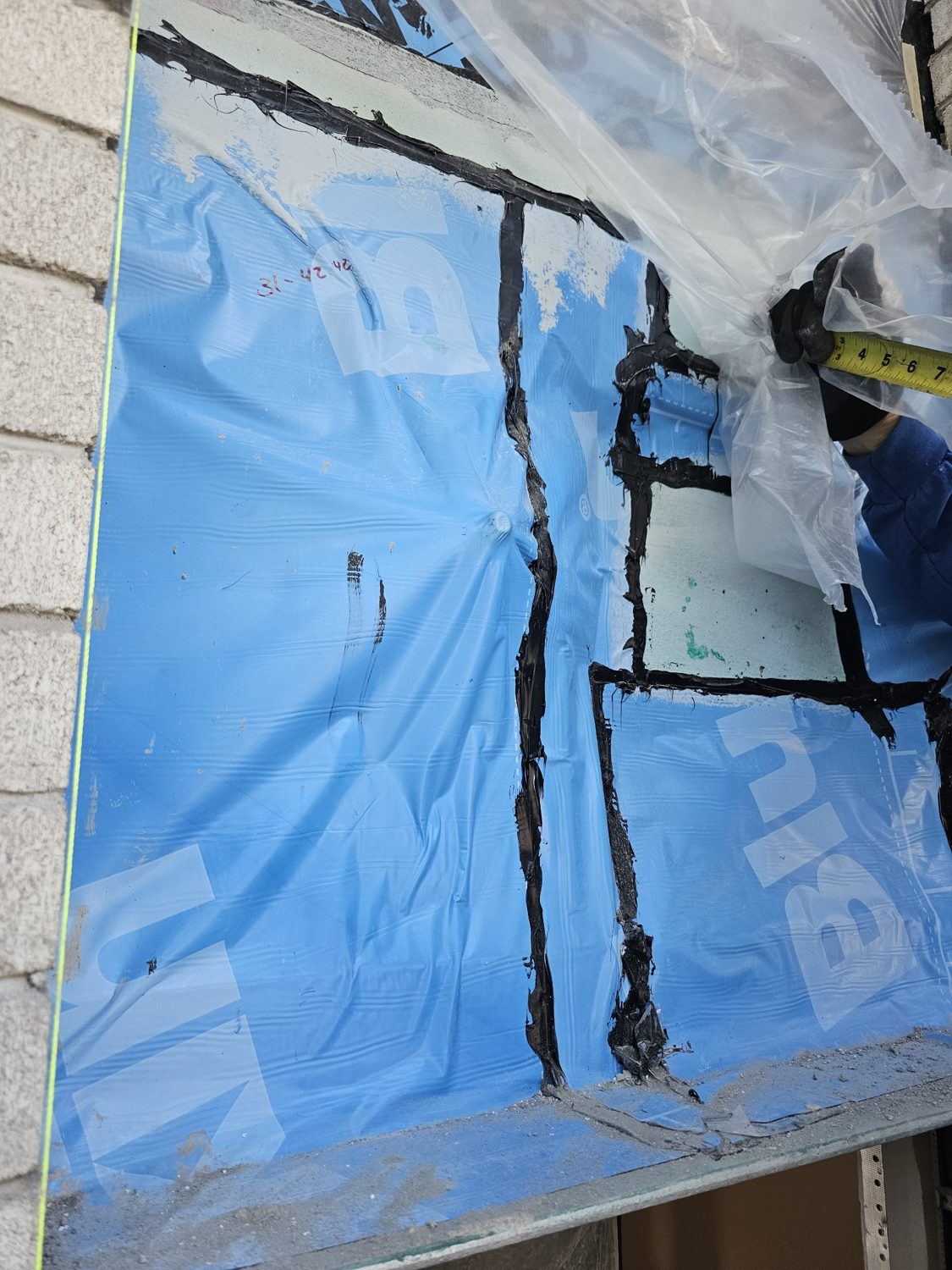
Look at what the picture shows:
A self-adhered membrane is designed to become part of the wall. Every square inch is meant to be glued down. When it is, water that gets past the outer wall meets the membrane, runs down its face and drains out at the bottom.
When it is not glued down, the sheet becomes a loose bag. Water that gets behind it, through one open seam, one nail hole or one unsealed corner, can travel in any direction between the sheet and the wall. It collects in the wrinkles and at the bottom. It cannot dry, because the membrane that should be keeping water out is now keeping it in.
Then the slow part begins. The wall stays damp. Black mold grows on the sheathing or the back of the finishes. A stain or a smell appears inside, often far from where the water got in. The window is blamed, or the roof, or the brick. Because the membrane is hidden behind the finished wall, nobody can see the real cause without opening it up.
Each manufacturer publishes its own instructions, and they are the rule for that product. The principles are the same for every self-adhered membrane:
Done this way the membrane looks dull, flat and tight to the wall. It should be difficult to lift a corner with your fingers.
The only time waterproofing can be inspected is before the window, the siding or the brick goes over it. Take five minutes:
If the answers are wrong, the fix at this stage is cheap: pull it off, prepare the surface and do it again. After the wall is closed, the same fix means taking the wall apart.
Once the installation is going to be done properly, the product choice is worth some thought: what the wall is made of, what the weather will be on the day, how long the membrane will be left exposed, and what it has to connect to at the window and the roof. We describe the systems we use in waterproofing solutions, and how the window opening is prepared in new construction window installation.
The first question is always who is putting it on, and whether they will follow the instructions.
There is no single best one. A good product installed badly fails, and a simpler product installed correctly works. Choose a product suited to the wall material and the weather, then make sure it is installed to the manufacturer’s instructions.
If it is not stuck down everywhere, water that gets behind it can travel between the sheet and the wall, collect there and stay wet. A fully bonded membrane leaves no space for water to move or sit.
One common cause is water trapped behind a waterproofing membrane that was not fully adhered or was lapped the wrong way. The wall cannot dry, and mold grows where nobody can see it.
Before it is covered, it should lie flat and tight with no wrinkles, bubbles or loose edges, the upper pieces should overlap the lower ones, and it should be hard to lift a corner by hand. Mastic smeared over the seams is a warning sign.
Yes. Blueskin by Henry is a widely used self-adhered air and water barrier. Like any membrane, it only works when it is fully bonded to a properly prepared surface.
Waterproofing Solutions Installation Services New Construction Window Installation Window Replacement Punched Windows All News
About this page. Written by Alex GC Inc. d/b/a Alex Glass Construction and reviewed before publication by Aleksandr Chernovolenko, Managing Partner, with our design and estimating lead and a field foreman. Our foremen hold the NYC DOB Site Safety Training supervisor card and our crews the 40-hour worker card; we are certified to fabricate, install and service Alutech and Everest aluminum systems. Facts are drawn from our own projects, manufacturer test data and the applicable codes; where we are giving an opinion, we say so. Last reviewed September 2026. Credentials
Send us photographs of the opening before it is covered, or of the stain if it already is. We will tell you what we see and what it would take to put right.