From bare opening to tested, weathertight window: the sequence, the details for each wall type, and what the general contractor needs to have ready.
On a new building the window is only as good as the way it is put in. The same unit can be weathertight for forty years or leak in its first storm, and the difference is the opening preparation, the flashing and the sealing. This article walks through new construction window installation step by step, as it is done on multifamily and commercial buildings in New York, and explains what the general contractor needs to have ready.
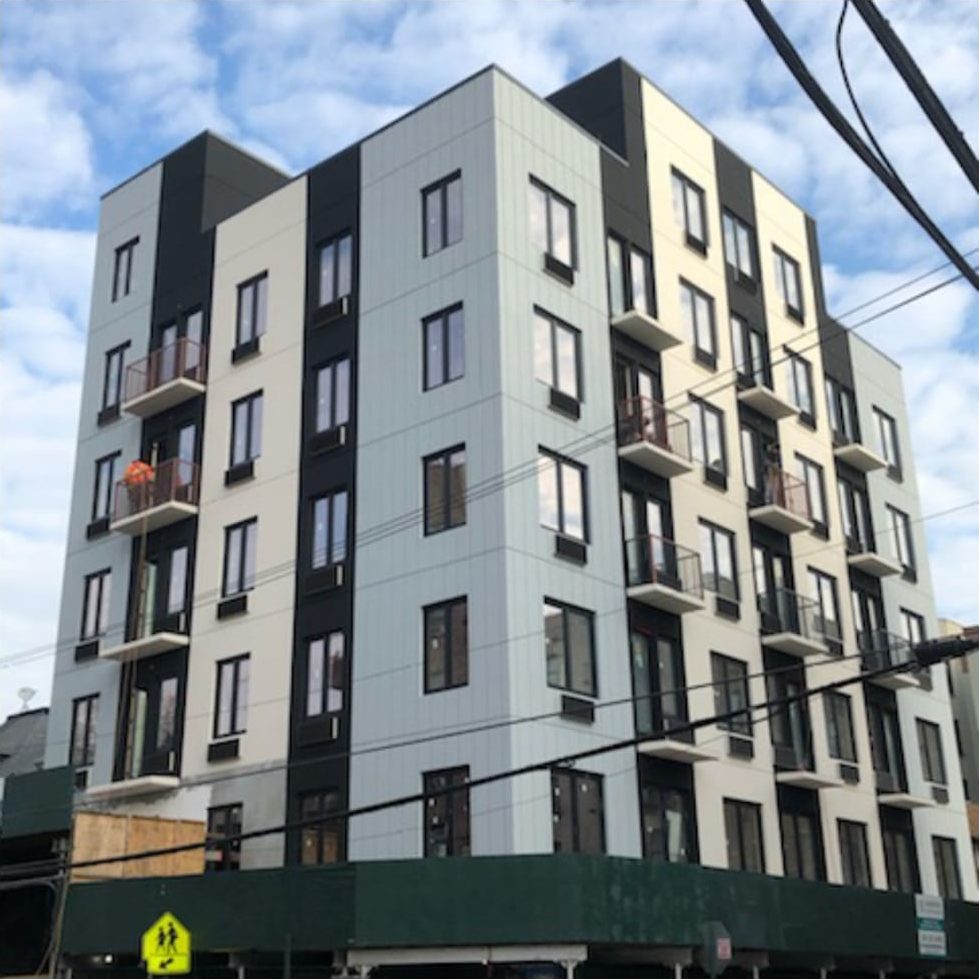
In a replacement job the installer works around what exists: old frames, finished interiors, occupied rooms. In new construction the opening is bare, and the window becomes part of the wall’s air and water barrier. That is an advantage, because every layer can be lapped in the right order, but only if the window is installed at the right moment in the facade sequence. Too early and it is damaged by other trades; too late and the flashing cannot be tied in.
Masonry and concrete openings take a block frame set within the depth of the wall and sealed to it. The usual questions are where the frame sits relative to the insulation line and how the sill extends past the face of the wall.
Steel stud and panel walls often use a frame with a receptor or subframe that is flashed into the sheathing before the window is dropped in. This lets the facade close up early.
Wood frame houses typically use a nail fin: the fin is fastened to the sheathing and taped into the housewrap.
Window wall and curtain wall are anchored to slab edges or embedded channels and need their own engineering. See curtain wall systems.
On larger projects the specification usually calls for a mock-up and for field water testing of a sample of installed windows, in which a calibrated spray rack wets the outside while the inside is held at a pressure difference. It is far cheaper to find a flashing error on the first three windows than on three hundred. We recommend testing the first units installed on every job, whether or not the specification requires it.
Good practice on any job: inspect each opening before the interior is closed, photograph the flashing, and record the anchors.
Speed depends on unit size, access and how ready the openings are. Punched windows in a mid-rise apartment building go quickly once a crew has a rhythm; on our Woodycrest Avenue project in the Bronx the windows for a 25-unit building were installed in two weeks. Large fixed lites, window wall and anything needing a crane are slower. The schedule usually fails not on the installation itself but on openings that are not ready or deliveries out of sequence.
Every one of these is avoidable with a mock-up, a checklist and one person responsible for the opening. For how we treat the joint between window and wall, see waterproofing.
Leaks at windows are usually leaks at the boundary between two trades. Before work starts, write down who supplies and installs the sill pan, who flashes the frame into the wall barrier, who applies the exterior sealant and who finishes the interior return. When one company installs the window and does the flashing and sealant, there is one party to call. When the work is split, a short marked-up detail signed by each trade prevents most arguments. The same applies to protection: agree who covers the sills and who removes the film.
The opening is checked, a sill pan is fitted, the frame is set plumb and level and anchored, flashing is lapped onto it, the perimeter is insulated and sealed inside and out, and the sashes are adjusted.
In new construction the window is fixed directly to the bare structure and flashed into the wall’s air and water barrier. A replacement window is fitted into an existing opening and finishes.
After the structure and air and water barrier are ready at the opening and before the exterior cladding closes the joint, in a sequence agreed with the facade trades.
Yes. A sloped sill pan with end dams is the main defence against leaks, because it drains any water that gets past the window to the outside.
It is required when the project specification says so, usually on larger buildings. Testing the first installed windows is good practice on any project.
New Construction Windows NYC Choosing a New Construction Window Supplier Windows for New Construction Buildings Commercial Windows for New Construction Aluminum Windows uPVC Windows Curtain Wall Systems Material Supply Portfolio All News
About this page. Written by Alex GC Inc. d/b/a Alex Glass Construction and reviewed before publication by Aleksandr Chernovolenko, Managing Partner, with our design and estimating lead and a field foreman. Our foremen hold the NYC DOB Site Safety Training supervisor card and our crews the 40-hour worker card; we are certified to fabricate, install and service Alutech and Everest aluminum systems. Facts are drawn from our own projects, manufacturer test data and the applicable codes; where we are giving an opinion, we say so. Last reviewed September 2026. Credentials
Send the window schedule, elevations or the architect’s specification section. We will price the package, with or without installation, and tell you the lead time.