A neutral-cure silicone made for sunroom and skylight glazing. We have a sample on the bench; here is what we will test it for, and how a fabricator or installer can get one free from the distributor.
Seimeda S807 is a single-component, neutral-cure silicone weatherproofing sealant made by Zhonggui Industrial (中硅实业) and labelled for architectural sunlight rooms — conservatories, sunrooms, skylights and glazed roofs, the joints that see the most sun and the most water on a building. Its North American distributor, NYCE Glass in Jersey City, is offering fabricators and installers a free sample to test. We have one on the bench, and this article says what it is, what we will test it for, and how to get your own.
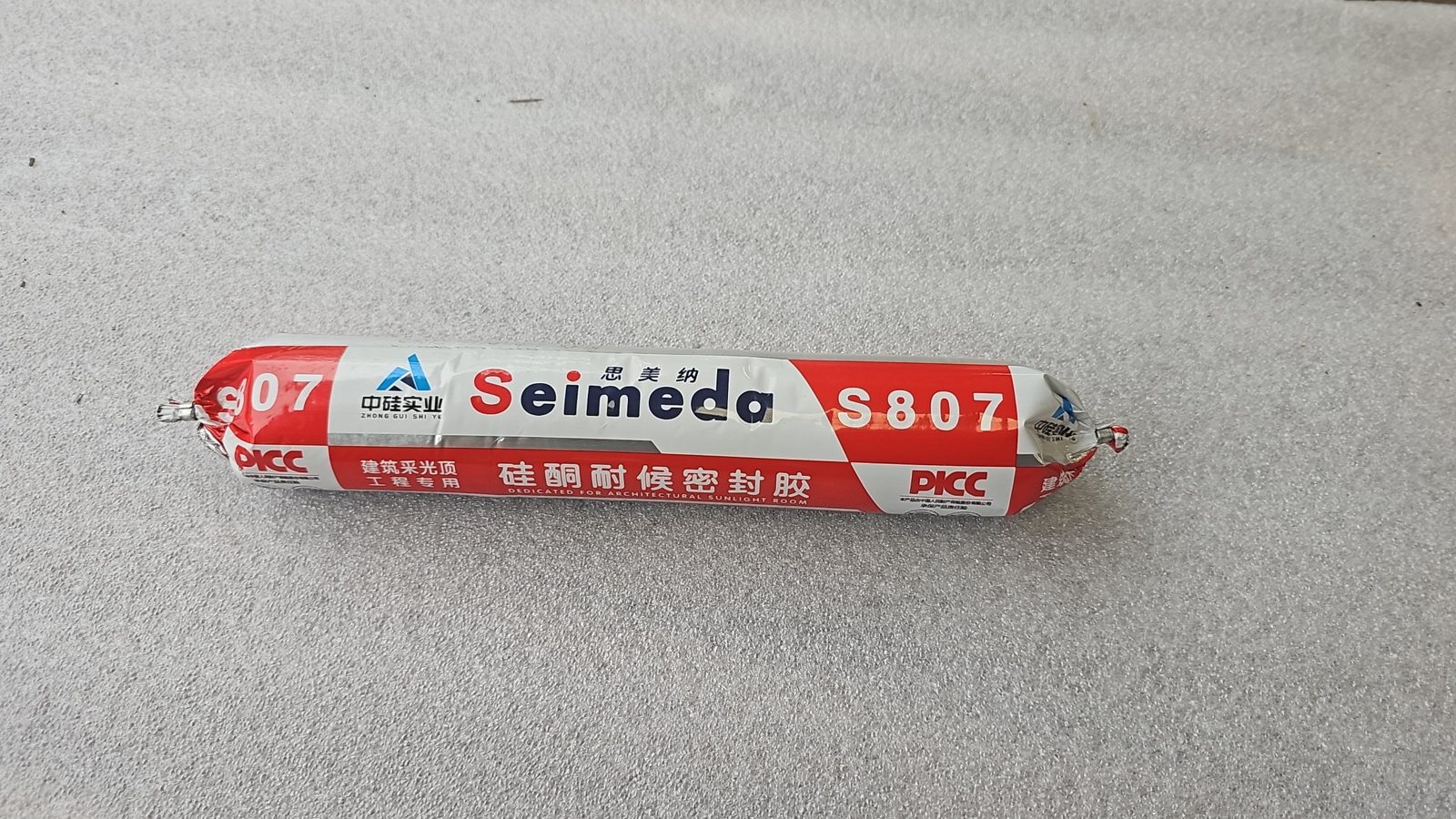
The sample on the bench: Seimeda S807 weatherproof silicone in a sausage pack, labelled for architectural sunlight rooms.
The sausage in the photograph is the standard 590 ml foil pack that goes into a bulk gun, the format a glazing crew uses for long runs of weather seal rather than the 300 ml cartridge. The label reads, in Chinese and English, “silicone weatherproof sealant — dedicated for architectural sunlight room”, with the grade S807, the maker’s name, Zhonggui Industrial, and a PICC mark: the product carries product-liability insurance underwritten by the People’s Insurance Company of China, which is how a Chinese sealant maker signals that it stands behind a construction-grade product.
Seimeda is already on our brand list as one of the sealants we use for weather seals, glazing beads and shower joints. S807 is the grade aimed at the hardest of those jobs: the sloped and overhead glazing of a sunroom, where a weather seal is in full sun all day, sees water lying on it rather than running off, and moves with an aluminium frame through every season.
A vertical window seal sheds water; a sunroom or skylight seal holds it. On a sloped or flat glazed roof the joint between glass and cap, or between two lites in a butt joint, is wet for hours after rain and baked for hours after that, and it moves more than a wall joint because the frame is thin and the glass is dark. A weather sealant for that duty needs high UV resistance, low modulus with real movement capability (±25% is the mark for a facade silicone), good unprimed adhesion to powder-coated and anodised aluminium and to glass, no sag on a slope, and a cure that does not stain the glass edge or attack the insulated unit’s secondary seal. Silicone is the only chemistry that does all of that, which is why sunroom and skylight work is silicone-only on our jobs; see skylights and the Morristown sunroom.
We do not publish what a data sheet says; we publish what the material did on our bench and on our jobs. The S807 sample goes through the same sequence we ran on our other sealants:
Adhesion. Beads on black powder-coated aluminium, clear anodised aluminium, float glass, low-E coated glass (surface 1) and polycarbonate, unprimed, cured 21 days at room temperature, then hand-peeled at 180 degrees the way the field adhesion test in ASTM C794 and C1521 does it. A pass is cohesive failure — the bead tears in itself rather than releasing from the surface.
Working properties. Skin time and tack-free time on the bench, gunnability from a bulk gun at 50 and 90 degrees Fahrenheit, tooling with a spatula and with a wetted finger, and sag on a vertical joint and on a 30-degree slope, because a sunroom sealant that slumps on the slope is useless whatever its adhesion.
Compatibility. A bead cured in contact with the edge of an insulated glass unit and with a black EPDM gasket, checked after 30 days for discolouration, softening and any migration into the IGU edge seal; sealant that attacks the secondary seal fogs the unit in a year.
Weathering. A test panel on the roof of our shop through the winter and the summer that follows, beside a panel of the DOWSIL weather sealant we use as the reference, compared for chalking, colour change and hardness. That is a year-long test and the result comes when it comes.
The results go on this page as they arrive, with photographs. If S807 passes we add it to the sealants we buy; if it fails a test we say which one.
Sunroom and conservatory roof glazing, skylight cap seals, the cap beads on curtain wall and storefront, the perimeter seal between a window frame and the wall, and the exterior bead on the fold-up and bifold units we set in restaurant fronts. Not structural glazing: S807 is a weather sealant, and glass that is held by silicone alone takes a structural silicone such as DOWSIL 795 or 995, which is a different product tested to a different standard. See DOWSIL and waterproofing.
The distributor is NYCE Glass, the North American representative for Seimeda, working from a warehouse at 152 Halladay Street in Jersey City. They stock the S805, S806 and S807 grades in black, bronze, white and clear, sell by the case of twenty sausages or by the single sausage, and deliver to the job site: free anywhere in the five boroughs with no minimum order, free out to fifty miles on larger orders, and by carrier beyond that. They also send the four-page laboratory report and the data sheets on request; the published figures are to the Chinese GB test standards rather than ASTM, which is exactly why we run our own tests before a sealant goes on a job.
To get the sample, place an order on nyceglass.com and write “free silicone” in the order note; the sample ships with the order. Test it the way you would test any new sealant — a bead on the substrates you actually use, cured and peeled — before it goes on a job, and if you want to compare notes on results, send us yours and we will add them here.
A single-component, neutral-cure silicone weatherproofing sealant from Zhonggui Industrial, labelled for architectural sunlight rooms: sunroom, conservatory and skylight glazing joints.
No. It is a weather sealant for exposed joints. Structural glazing, where silicone holds the glass, uses a structural silicone tested to ASTM C1184 such as DOWSIL 795 or 995.
That the manufacturer carries product-liability insurance with the People’s Insurance Company of China for that product.
The sealant cures by reacting with moisture in the air without releasing acetic acid, so it does not corrode aluminium, attack coatings or etch mirrors, and it has little odour.
Order through the distributor NYCE Glass at nyceglass.com and write “free silicone” in the order note; the sample ships with the order.
Yes. The company works from a warehouse in Jersey City and delivers to job sites across the New York metro: free in all five boroughs with no minimum order, free within fifty miles on larger orders, and by carrier beyond that.
Not yet. We are testing the sample for adhesion, working properties, compatibility and weathering, and the results will be posted on this page.
About this page. Written by Alex GC Inc. d/b/a Alex Glass Construction and reviewed before publication by Aleksandr Chernovolenko, Managing Partner, with our design and estimating lead and a field foreman. Our foremen hold the NYC DOB Site Safety Training supervisor card and our crews the 40-hour worker card; we are certified to fabricate, install and service Alutech and Everest aluminum systems. Facts are drawn from our own projects, manufacturer test data and the applicable codes; where we are giving an opinion, we say so. Last reviewed September 2026. Credentials
Send a photo of the joint and the frame finish and we will tell you what to use and how to detail it.