How a stained glass panel is made — cartoon, glass selection, cutting, foiling or leading, the soldering that decides it — why no two are alike, where it belongs in a New York building, and how we protect and install it.
Stained glass is the one glass product that is made by hand from the first line to the last. A panel begins as a drawing, becomes several hundred pieces of coloured glass cut one at a time, and is joined into a single sheet with lead and solder by someone who has done it for years. No two panels are the same because no two sheets of art glass are the same and no two solder lines are the same; that is what makes it art, and what makes it slow. This page explains how a panel is made, why it takes what it takes, and how we design, build, protect and install stained and leaded glass in New York.
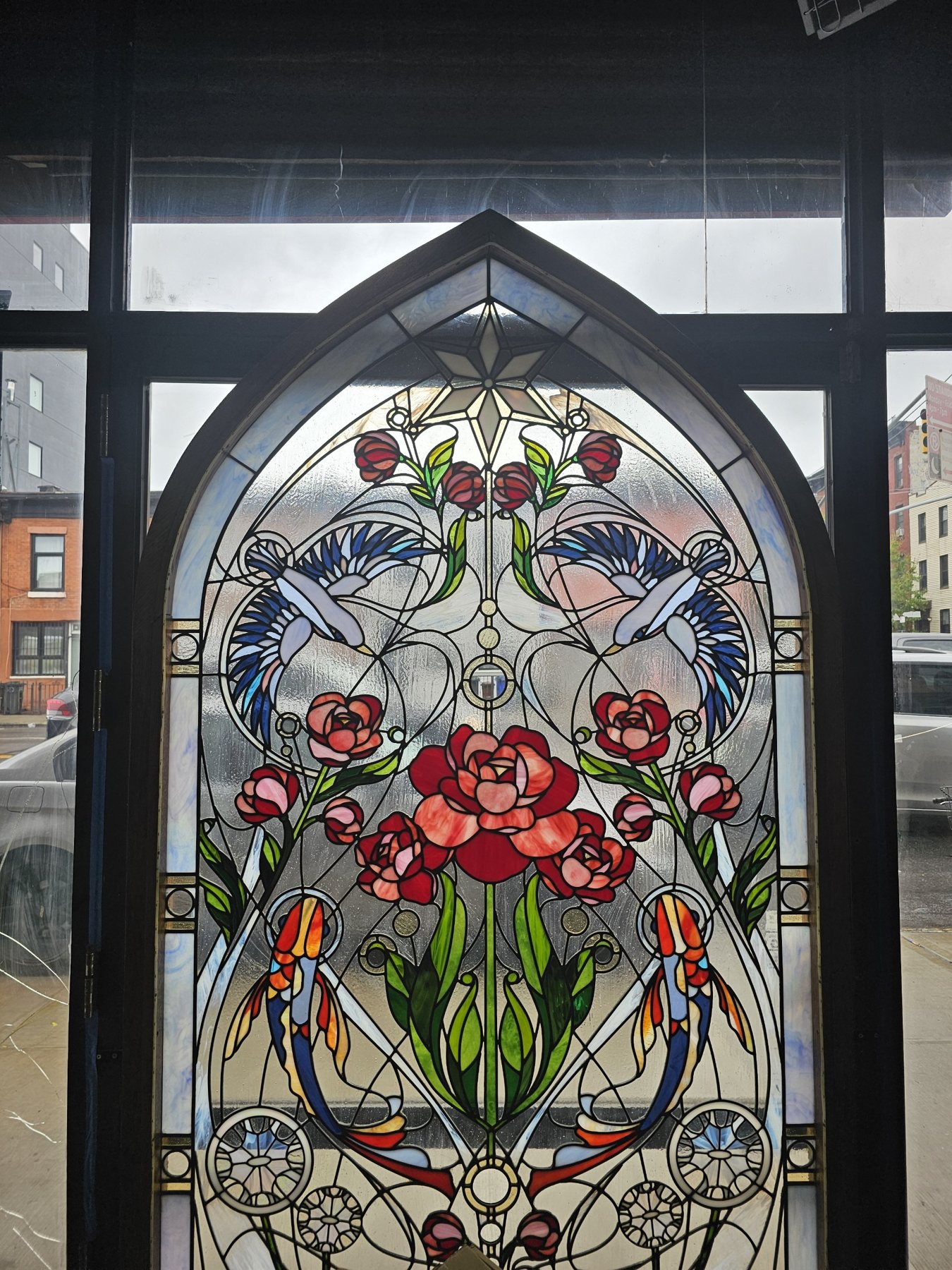
Stained glass is coloured glass — coloured in the melt, not painted on the surface — cut into shapes and joined into a panel with metal: lead came, the H-shaped channel of the medieval and Victorian tradition, or copper foil, the Tiffany method that lets the pieces be smaller and the lines finer. Painted detail (a face, a feather, a shadow) is fired onto individual pieces in a kiln before assembly. It is not a printed film, not a colour laminated between two sheets, and not the “stained glass effect” sold in hardware stores; those imitate the look and lose it at the first change of light. Real stained glass reads differently every hour of the day, because the light is coming through a thousand small facets of different thickness and texture rather than through one flat pane.
Every panel starts as a full-size drawing, the cartoon, drawn to the exact opening. The designer works in lines that will become lead or solder, which means every shape has to be cuttable in glass: no interior corners a cutter cannot turn, no piece so thin it will snap, no line that carries no structural load across a big span. A rose with forty petals is forty pieces and forty decisions about which petal overlaps which; a face is a single piece that will be painted and fired. The cartoon is traced twice, once as the pattern the pieces are cut from and once as the assembly guide the panel is built on.
This is where the panel becomes unique. Art glass is made by hand in small batches — cathedral glass (transparent, one colour), opalescent (milky, streaked), wispy, seedy, rippled, hammered, drapery glass that folds like cloth — and every sheet is different in colour and texture from the next. The maker lays each pattern piece on the sheet and moves it until the streaks in the glass follow the shape: a petal cut where the red runs pink at the edge, a leaf where the green darkens along the vein, a sky piece where the clear glass has just enough movement to catch the light. Two panels from the same cartoon, cut by the same hands from different sheets, will not be the same panel. Antique and restoration glass — mouth-blown, with the waver and the bubbles of the nineteenth century — is used where a panel must sit beside originals.
Each piece is scored with a carbide or diamond wheel and snapped along the score, then ground on a diamond bit to the exact line of the pattern. Curves are cut in a series of scores; inside curves are the hardest and the most likely to break; a piece that breaks is cut again from another part of the sheet, and the pattern is adjusted if the glass will not allow the shape. On a complex panel a maker will cut and grind three hundred to six hundred pieces, and the fit has to be within the width of a solder line, because every gap becomes a thick line and every overlap a piece that will not sit flat.
In the copper-foil method every piece is wrapped on its edge with a thin adhesive copper tape, burnished tight, and the pieces are laid together on the cartoon so the foil edges touch. This is the method for fine work — the roses and koi in the panels on this page, small pieces, tight curves, lines that thin and thicken. In the lead came method the pieces are set into H-section lead channel, stretched and cut to each line, and the panel is built outward from one corner with each came holding the piece before it; this is the method of church windows, transoms and most Victorian domestic panels, stronger over large areas and with a bolder line. Many panels use both: came around the border and along the structural lines, foil for the detail inside.
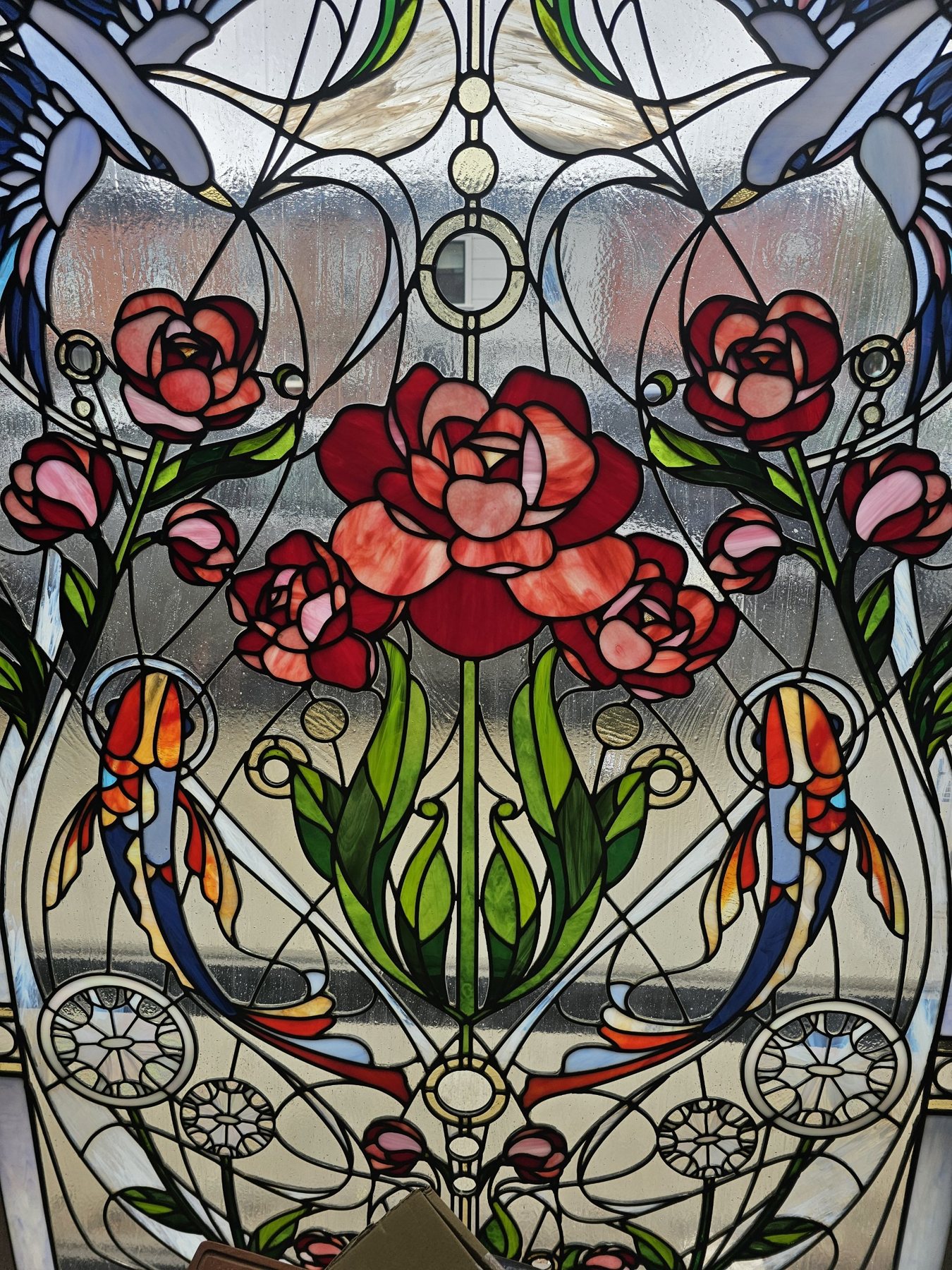
The panel is joined with solder — an alloy of tin and lead, melted with a hot iron and run along every foil seam or came joint. On a foiled panel every seam on both faces is soldered, which on a panel with five hundred pieces is well over a thousand feet of joint. The bead has to be raised, rounded and even, the same width and height on a straight border line and on a curl of tracery an eighth of an inch long, with no pinholes and no flat spots, because the solder line is the drawing: it is what the eye reads as the outline of every rose, bird and leaf. That evenness is a physical skill, iron temperature and hand speed and the feel of the flux, and it takes years. On a leaded panel the joints are soldered where cames meet, front and back, and the cames themselves stay as the line. Afterwards the solder is cleaned of flux, patinaed black, copper or left silver, and waxed.
A leaded panel is cemented: a putty-like compound is brushed under the lead flanges on both faces to lock every piece, stiffen the panel and make it weathertight, then cleaned off and cured. Panels over a certain size get reinforcement — steel or brass bar soldered across the back, or reinforcing strip hidden inside the came — because lead creeps under its own weight and a large unsupported panel will bow within a decade. The panel is then framed: in a zinc or brass border came, in a wood frame, or set into the sash it will live in. Only then is it glass you can hang in a window.
A panel like the Gothic arch on this page is two to four weeks of one person’s work: a day or two on the cartoon, days selecting and cutting glass, days foiling, days soldering both faces, a day finishing. Larger church or landmark commissions take months. The cost follows the count and the difficulty of the pieces, not the square footage — a plain leaded transom with forty pieces of clear textured glass is a modest commission; a figurative panel with painted faces is a work of art priced like one. There is no faster way to make it, and the attempts to make it faster — printed films, resin lines, mass-produced hobby panels — are the reason people are disappointed by “stained glass” that is not.
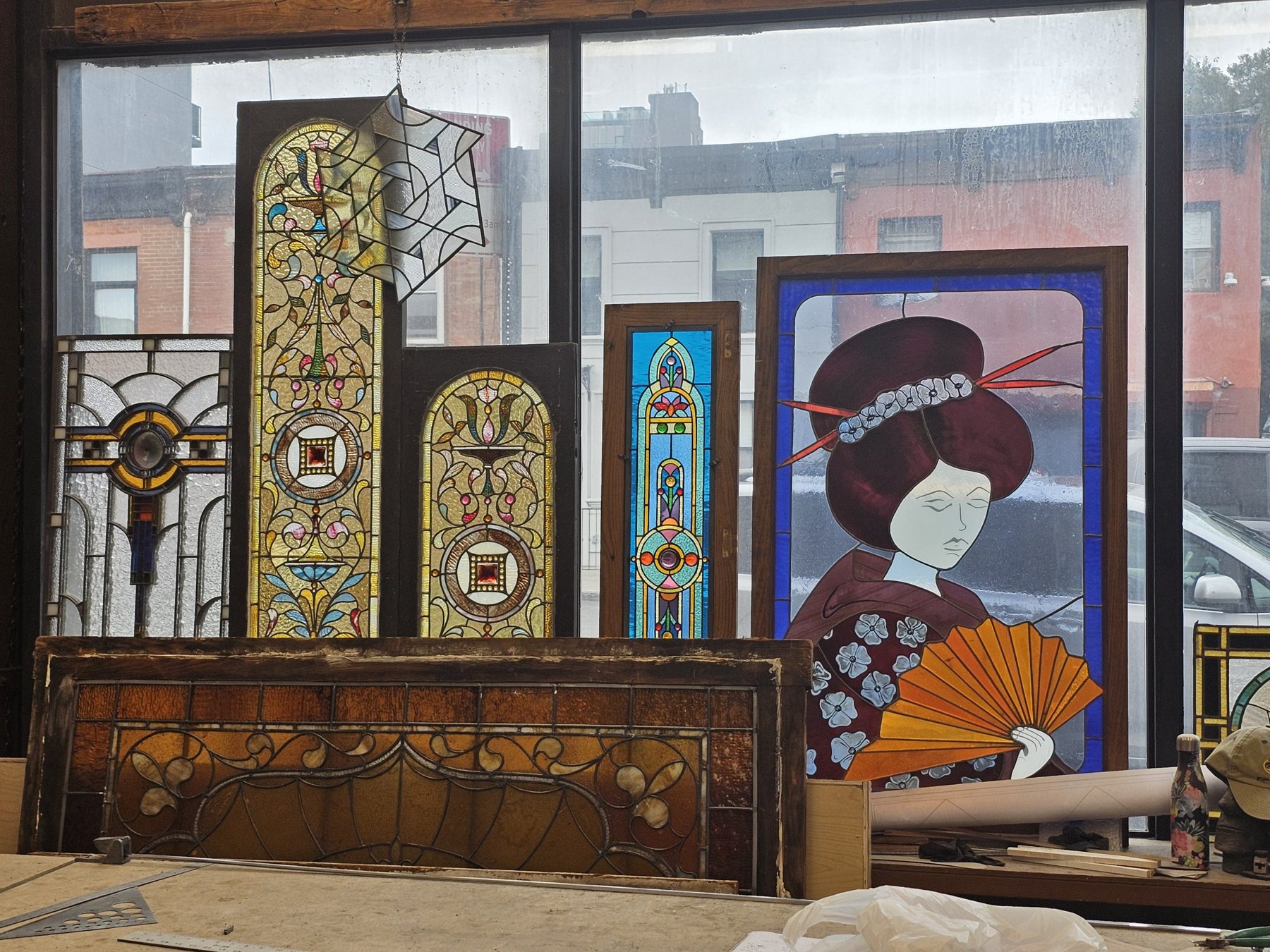
Transoms and fanlights over brownstone and townhouse doors, where a Victorian original often survives and a new panel is made to match it. Stair landing windows in pre-war houses, the classic place for a leaded panel because it lights the stair and screens the neighbour. Bathroom and powder-room windows for privacy with colour. Church, synagogue and chapel windows — restoration of the originals and new commissions. Door lites and sidelites, interior partitions, cabinet doors, and the backlit panels that make a bar or a restaurant. And restoration: pre-war panels that have bowed, cracked or lost pieces are taken out, releaded on the original cartoon with the original glass where it survives, and put back.
A hand-made panel is not a weather barrier and should not be asked to be one. We set stained glass behind or inside modern glazing: as the interior lite of a purpose-built insulated unit, with the panel sealed between two sheets of clear tempered or laminated glass, so it is protected from weather, dirt and impact and the window meets the energy code; or as an interior panel in a wood or aluminium frame behind a clear exterior window, the usual arrangement on a landmark facade where the exterior sash must match the street. On churches and institutional buildings we install vented protective glazing so the leaded panel can breathe. In every case the frame, the flashing and the exterior glass are ours, made in the shop and installed by our crews; the art is protected by the same envelope that keeps water out of the rest of the building. See insulated glass units, transom windows and landmark window replacement.
Tell us the opening and what you want it to do — match an original, screen a view, carry a motif, mark a room. We survey the opening and photograph any original. Our panels are made by Karen, the stained glass artist we work with: she prepares a scaled sketch and glass samples for approval, then the cartoon, and cuts, foils or leads, solders and finishes the panel by hand as described above. We build the frame or the insulated unit around it and install it with the rest of the window work. For restoration we take the panel out, document it piece by piece, relead it on the original pattern, and return it in protective glazing. Lead times run four to twelve weeks for a domestic panel and longer for large or figurative work. Related: frosted and patterned glass for privacy without colour, painted glass and antique mirror for other decorative glass.
Leaded glass is any panel of glass pieces joined with lead came; stained glass is leaded or copper-foiled glass in colour, often with painted and fired detail. A clear textured Victorian transom is leaded glass; a rose window is stained glass.
Copper foil wraps each piece in thin copper tape and solders every seam, allowing small pieces and fine lines (the Tiffany method). Lead came sets pieces into H-section lead channel soldered at the joints, stronger over large areas with a bolder line. Many panels use both.
Every piece is cut, ground, wrapped and soldered by hand, and a domestic panel can have several hundred pieces and over a thousand feet of solder line. A panel is days to weeks of one skilled person’s work; the price follows the piece count and difficulty, not the square footage.
On its own, no; it is single glass with metal joints. We set the panel inside a purpose-built insulated unit or behind a clear exterior window, so the window meets the energy code and the art is protected.
Yes. Bowed, cracked or incomplete pre-war panels are removed, documented, releaded on the original pattern with original glass where it survives, and reinstalled in protective glazing.
On a landmark facade the exterior sash must match the street; the stained glass usually sits behind a clear exterior window or inside an insulated unit in a matching frame. Original leaded transoms are generally required to be kept or reproduced.
Four to twelve weeks for a domestic panel from approved design; large, figurative or church commissions take months.
Glass Types & Specifications Frosted & Patterned Glass Painted Glass Antique Mirror Transom Windows Insulated Glass Units Landmark Window Replacement
About this page. Written by Alex GC Inc. d/b/a Alex Glass Construction and reviewed before publication by Aleksandr Chernovolenko, Managing Partner, with our design and estimating lead and a field foreman. Our foremen hold the NYC DOB Site Safety Training supervisor card and our crews the 40-hour worker card; we are certified to fabricate, install and service Alutech and Everest aluminum systems. Facts are drawn from our own projects, manufacturer test data and the applicable codes; where we are giving an opinion, we say so. Last reviewed September 2026. Credentials
Send a photograph of the opening or the original panel and its size. We will come back with a sketch, glass samples and a price for the panel, the protective glazing and the installation.