Where a mirror may be hit or fallen into, glass is the wrong material. Acrylic mirror reflects like glass, weighs under half as much, and does not shatter. What it is, where it belongs, where glass is still better, and how we supply and install it.
In short: If a mirror has to go where it may be hit, kicked, leaned on or fallen into, a home gym, a children’s room, a school, a dance studio, a daycare, a rental unit, a boat or an RV, the shatterproof answer is an acrylic mirror: a sheet of cast or extruded acrylic with a vacuum-metalized mirror coating and a hard protective backing. It reflects like glass, weighs less than half as much, and when it is struck it flexes or cracks instead of breaking into shards. We supply Fabback acrylic mirror cut to size, up to 48 × 96 inches standard and 80 × 120 inches to order, in thicknesses from 1/16" to about 1/4", and we install it. Where glass is still the right call, we say so below.
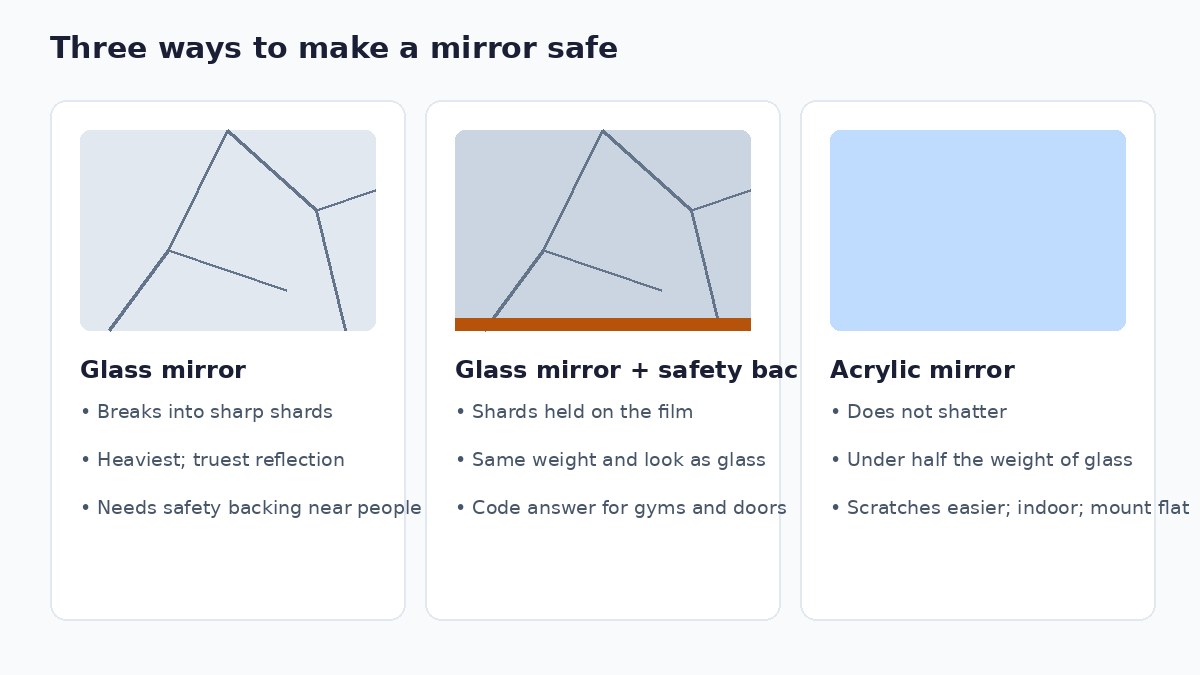
A glass mirror is glass with silver on the back. Hit it hard enough and it breaks the way glass breaks: into long, sharp pieces that fall out of the frame. That is why building codes require safety glazing for mirrors on doors and in certain locations, and why a plain mirror wall in a gym, a studio or a kids’ playroom is a liability waiting for a dropped dumbbell or a cartwheel. The usual fixes are a safety backing film bonded to the back of the glass, which holds the pieces together when it breaks, or laminated mirror, which does the same with an interlayer. Both still break. They just break safely.
Acrylic mirror takes a different route: it does not break. The sheet bends under impact, and a hard blow will crack it or dent it, but there are no shards and nothing falls out of the wall. For a room where the people are small, fast, or carrying weights, that is the difference that matters.
The product we supply is Fabback, made by Plaskolite from their Optix acrylic sheet. The acrylic is continuously processed for flatness, a mirror layer is applied by vacuum metalizing, and the back is sealed with what the manufacturer calls the industry’s toughest protective back coating, so the reflective layer is not scratched or lifted during handling and installation. The face is clear acrylic, so the reflection is bright and neutral, with none of the green cast that standard glass gives at the edge.
| Thicknesses | 0.060", 0.080", 0.118", 0.220" and 0.236" (roughly 1/16" to 1/4"); run-to-size from 0.060" to 0.236" |
| Standard sheet | 48 × 96 in; also 60 × 96 and 72 × 96 in stock |
| Custom sizes | 36 × 60 in up to 80 × 120 in, run to size; sheets come with a 1-inch overage on length and width for trimming |
| Colors | Clear (silver) standard; custom colors to order |
| Weight | Specific gravity 1.19, against about 2.5 for glass: under half the weight of a glass mirror of the same thickness |
| Masking | Protective film or paper on the face, removed after installation; a laser-cuttable film is available |
| Service temperature | Up to 160°F continuous; indoor use |
| Fire data | Burning rate 1.019 in/min (ASTM D635); smoke density 3.4% (ASTM D2843); self-ignition 833°F (ASTM D1929) |
| Hardness | Rockwell M-95 (ASTM D785); harder than most plastics, softer than glass |
Figures are the manufacturer’s published data for the acrylic substrate and the finished sheet. For a specific project we confirm the thickness and size against the opening and the mounting.
Acrylic mirror is not a glass mirror, and it is honest to say where it loses:
Put simply: acrylic where safety and weight decide, glass where the reflection and the finish decide, and safety-backed glass where you want both and the wall is flat.
We cut acrylic mirror to size in the shop, with square, radius or shaped edges, holes for standoffs and cutouts for outlets, and deliver it with the protective film on. Installation is to a flat, dry substrate: adhesive designed for acrylic mirror (not standard mirror mastic, which can attack the backing), applied in vertical beads so the sheet can breathe, with J-channel, clips or standoffs where the edge needs support, and a small gap at the edges for thermal movement. On a gym or studio wall we usually recommend 0.220" or 0.236" sheet over a plywood or MDF backer for the flattest reflection. The film comes off at the end; we explain why we leave it on until then in this article.
Send us the wall size, a photo of the room and what it is used for, and we will quote acrylic mirror, safety-backed glass mirror, or both, supplied or installed, across New York City, Long Island and New Jersey. See also free mirror samples and the mirror section of the gallery.
An acrylic mirror. It reflects like glass, weighs under half as much, and flexes or cracks instead of breaking into shards. For a large flat wall where the finest reflection matters, a glass mirror with safety backing is the alternative; it still breaks, but the pieces stay on the film.
Close. The reflection is bright and color-neutral; the difference is flatness. Thin sheet follows the wall it is mounted on, so we use thicker sheet and a flat backer where the reflection matters.
Yes, more easily than glass. Clean it with a soft cloth and a plastic-safe cleaner, never ammonia or paper towels, and keep grit off it.
Standard 48 by 96 inches, with 60 by 96 and 72 by 96 in stock, and run-to-size sheets up to 80 by 120 inches. We cut any size and shape below that.
It can, but over a vanity we recommend glass: it is looked at closely, cleaned daily and lives with steam. Acrylic is the choice where impact, weight or a child is the concern.
On a flat, dry wall or backer, with an adhesive made for acrylic mirror applied in vertical beads, plus channel, clips or standoffs at the edges, and a small gap for movement. Standard mirror mastic can damage the backing and is not used.
Yes. We cut it to size in our shop and install it across New York City, Long Island and New Jersey, or supply it cut to size for your installer.
Mirrors and reflective glass Free mirror samples Jersey City gym mirror wall Antique mirror Tempered glass Request a quote
About this page. Written by Alex GC Inc. d/b/a Alex Glass Construction and reviewed before publication by Aleksandr Chernovolenko, Managing Partner, with our design and estimating lead and a field foreman. Our foremen hold the NYC DOB Site Safety Training supervisor card and our crews the 40-hour worker card; we are certified to fabricate, install and service Alutech and Everest aluminum systems. Facts are drawn from our own projects, manufacturer test data and the applicable codes; where we are giving an opinion, we say so. Last reviewed September 2026. Credentials
Send the wall size, a photo of the room and what it is used for. We will quote acrylic mirror or safety-backed glass mirror, cut to size, supplied or installed.