Also sold as grey mirror and smoke mirror. What gives it the colour, what it does to a room that a clear mirror cannot, and practical ideas for houses, apartments and offices.
A gray mirror is a real silvered mirror made on gray-tinted glass instead of clear glass. The colour is in the glass itself, not in a film or a coating, so it cannot peel or fade. Because the light has to pass through the tinted glass twice — in to the silver and back out — the reflection comes back darker, cooler and softer than in an ordinary mirror. You still see a true image, but with the brightness turned down. The trade also calls it grey mirror (the British spelling), smoke mirror or smoked mirror; they are the same product. Designers use it where a clear mirror would be too bright or too literal: feature walls, bar backs, wardrobe doors, reception areas and elevator lobbies.
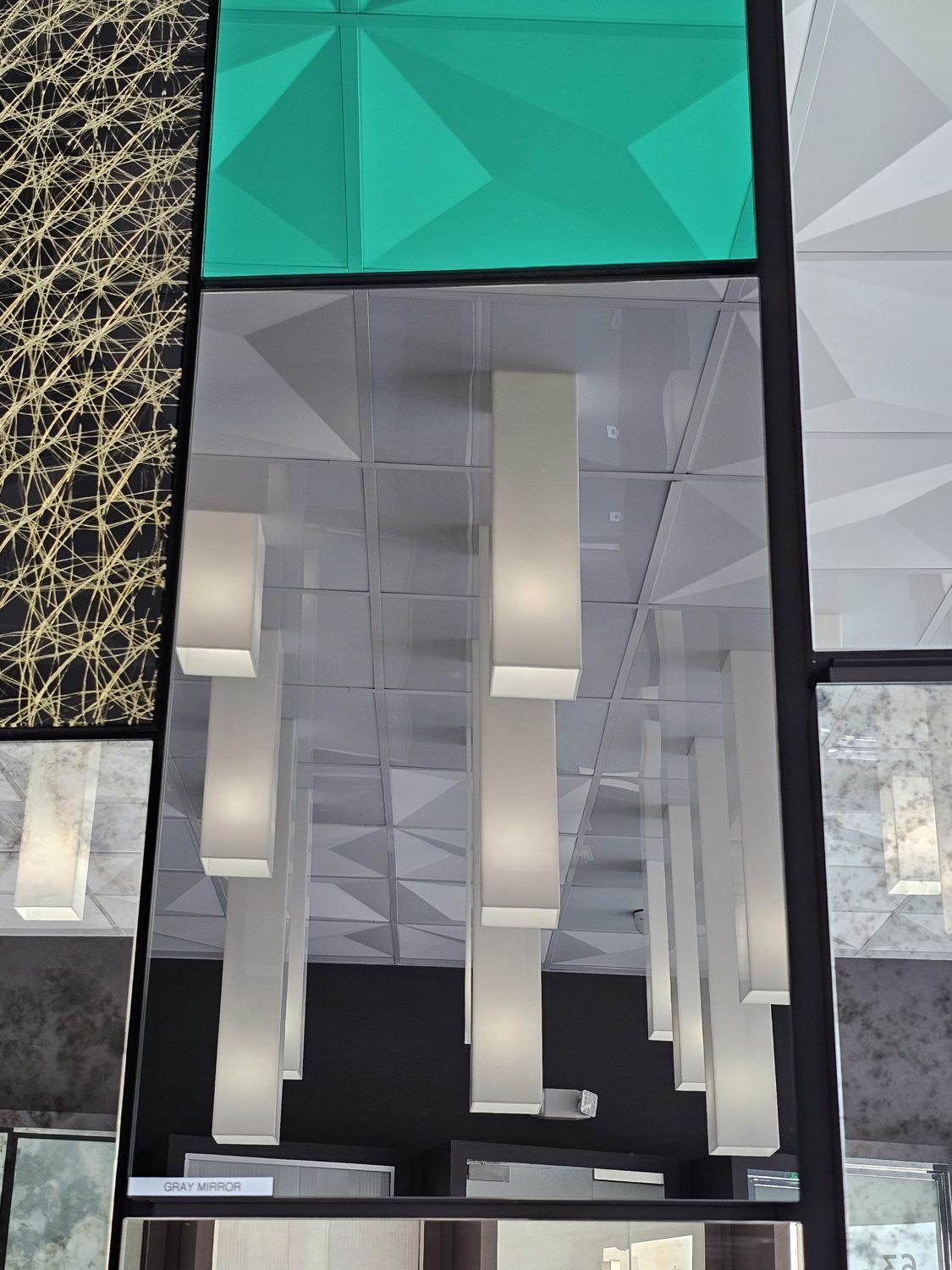
Production happens in two stages, and it helps to understand both, because they explain how the product behaves once it is on your wall.
Stage one: the tinted glass. Gray glass is ordinary float glass with the colour added in the furnace. Small amounts of metal oxides are mixed into the molten batch — typically combinations of iron, cobalt and nickel or selenium — and the glass is then floated on molten tin into a flat, even ribbon exactly like clear glass. The result is body-tinted: the gray runs through the full thickness of the sheet. This is the same material sold as tinted glass for windows and partitions.
Stage two: silvering. The tinted sheet goes down a mirror line. The back surface is scrubbed and rinsed with demineralised water, then sensitised with a tin solution so that silver will bond to it. A silver solution and a reducing agent are sprayed on together and a thin, continuous layer of metallic silver deposits on the glass. That silver is delicate, so it is protected immediately: traditionally with a layer of copper, and on modern copper-free lines with a chemical passivation layer instead. Finally one or two coats of backing paint are applied and oven-cured. The paint is what you see on the back of any mirror, and it is what keeps moisture and air away from the silver.
So a gray mirror is built in this order, front to back: gray glass, silver, protective layer, backing paint. Nothing is applied to the face. That matters for cleaning and for durability — the surface you touch is plain glass.
Why thickness changes the colour. Because the tint is in the body of the glass, a thicker sheet is darker. A 1/4-inch gray mirror reflects visibly less light than a 1/8-inch one from the same manufacturer. As a rough guide, a clear mirror returns around ninety percent of the light that hits it, and a gray mirror somewhere around a third to a half, depending on the glass and the thickness. Shades also vary between manufacturers, so all the panels for one room should come from one batch, and the choice should be made from a physical sample, not a photograph.
What it is not. A gray mirror is not a clear mirror with a tinted film on it, not a two-way mirror, and not an antique mirror, where the silver itself is deliberately distressed. Bronze mirror is made the same way on bronze-tinted glass and gives a warm reflection where gray gives a cool one.
Gray mirror is cut, drilled and edged like any mirror. Edges can be seamed, flat polished or bevelled; cut-outs for outlets, switches and sconces are made in the shop from a template. The practical limits are the same as for clear mirror:
A clear mirror doubles a room and doubles its light. That is exactly what you want over a vanity, and often too much on a whole wall: every lamp, window and passer-by is repeated at full strength, and the wall can feel busy or even glaring.
A gray mirror keeps the depth and drops the glare. The room still appears larger, because you still see a reflected space, but the reflection sits back like a shadowed copy of the room. Bright windows become soft panels of light. Pendant lights and candles read as glowing shapes instead of hot spots. Dark finishes — black steel, walnut, charcoal paint — look richer in it, and pale rooms gain contrast. It also photographs well, which is one reason it turns up so often in hospitality and showroom design.
The one thing it does poorly is the job of a working mirror. Skin tones come back darker and cooler, so it is the wrong glass for shaving, make-up or a fitting room. Use clear or low-iron mirror where people need to see themselves accurately, and gray where the mirror is part of the architecture.
Panel layout. Large panels with tight, straight butt joints look architectural. Smaller bevelled tiles look decorative and a little vintage. Decide which, and line the joints up with something in the room — a door head, a shelf, a cabinet line.
Trims and reveals. Thin brass, bronze or black metal strips between panels turn the joints into a feature. A shadow gap at the ceiling and floor makes the wall look like a set panel instead of a tiled surface.
Mixing with other glass. Gray mirror next to antique mirror, clear mirror or back-painted glass gives a patchwork that is more interesting than any one of them alone, as the display wall in the photograph shows. Keep the thicknesses equal so the faces sit flush.
Lighting. Light the things in front of the mirror, not the mirror. Wall washers aimed at the glass only show dust. Backlighting works well: a panel stood off the wall with LED behind its edges appears to float; see our mirrors page for backlit mirrors.
What it reflects. Stand where the mirror will be and look the other way. That is what it will show. A gray mirror opposite a window or a good piece of joinery is a success; opposite a cluttered kitchen counter it is not.
Materials that suit it. Warm metals, dark timber, veined marble, velvet and leather. Gray mirror is cool, so it benefits from something warm beside it.
The wall needs to be flat, dry and sound; a mirror follows whatever is behind it, and a wavy wall gives a wavy reflection. Panels are templated on site, including every outlet and switch, and cut in the shop. They are fixed with a mirror mastic that is safe for the backing paint, usually with a J-channel or concealed clips carrying the weight at the bottom. Ordinary acetic-cure silicone and some construction adhesives attack the silver and show through as dark stains months later, which is the most common way a mirror wall is ruined.
In use, the enemy is moisture at the edges. Water or cleaner that sits on the bottom edge creeps behind the paint and blackens the silver. Clean with a soft cloth and a small amount of glass cleaner sprayed on the cloth, not on the mirror, and avoid ammonia-heavy or abrasive products. Treated that way a gray mirror lasts as long as the room does.
A real silvered mirror made on gray-tinted float glass. The colour is in the glass, so the reflection is darker and cooler than a clear mirror and the tint cannot peel or fade.
Yes. Gray mirror, grey mirror, smoke mirror and smoked mirror are trade names for the same product. Shades vary between manufacturers and with thickness, so choose from a physical sample.
Gray glass is coloured with metal oxides in the furnace, then silvered on the back: cleaned, sensitised, coated with silver, sealed with a copper or copper-free protective layer and finished with cured backing paint.
It is not ideal for the face, because skin tones look darker and cooler. Use clear or low-iron mirror at the vanity and gray mirror as the surrounding or feature wall, with the edges kept dry and sealed.
Conventional silvered mirror cannot be tempered after silvering. Where safety matters it is supplied with a safety backing film or as laminated mirror.
A clear mirror reflects around ninety percent of the light; a gray mirror roughly a third to a half, depending on the glass and thickness. Thicker glass is darker.
Gray mirror is a clean, even reflection in a darker tone. Antique mirror has deliberately distressed, mottled silvering. They are often used together.
Mirrors & Reflective Glass Antique Mirror Tinted Glass Back-Painted Glass Glass Partitions Gym Mirror Wall, Jersey City Backlit Mirrors, SoHo
About this page. Written by Alex GC Inc. d/b/a Alex Glass Construction and reviewed before publication by Aleksandr Chernovolenko, Managing Partner, with our design and estimating lead and a field foreman. Our foremen hold the NYC DOB Site Safety Training supervisor card and our crews the 40-hour worker card; we are certified to fabricate, install and service Alutech and Everest aluminum systems. Facts are drawn from our own projects, manufacturer test data and the applicable codes; where we are giving an opinion, we say so. Last reviewed September 2026. Credentials
Send a photo of the wall with rough sizes. We will bring gray, bronze and antique mirror samples, template the wall and quote it.