A blue velour glass with a mirror bonded behind it, and a frosted clear glass to set against it. What we saw when the samples arrived.
Two pieces of glass arrived at the office this week, each about the size of a paperback. One is blue. The other is white, or as near to white as clear glass gets. They are samples for a project, and before anything is ordered at full size we wanted to see how they behave in real light. This is what we saw.
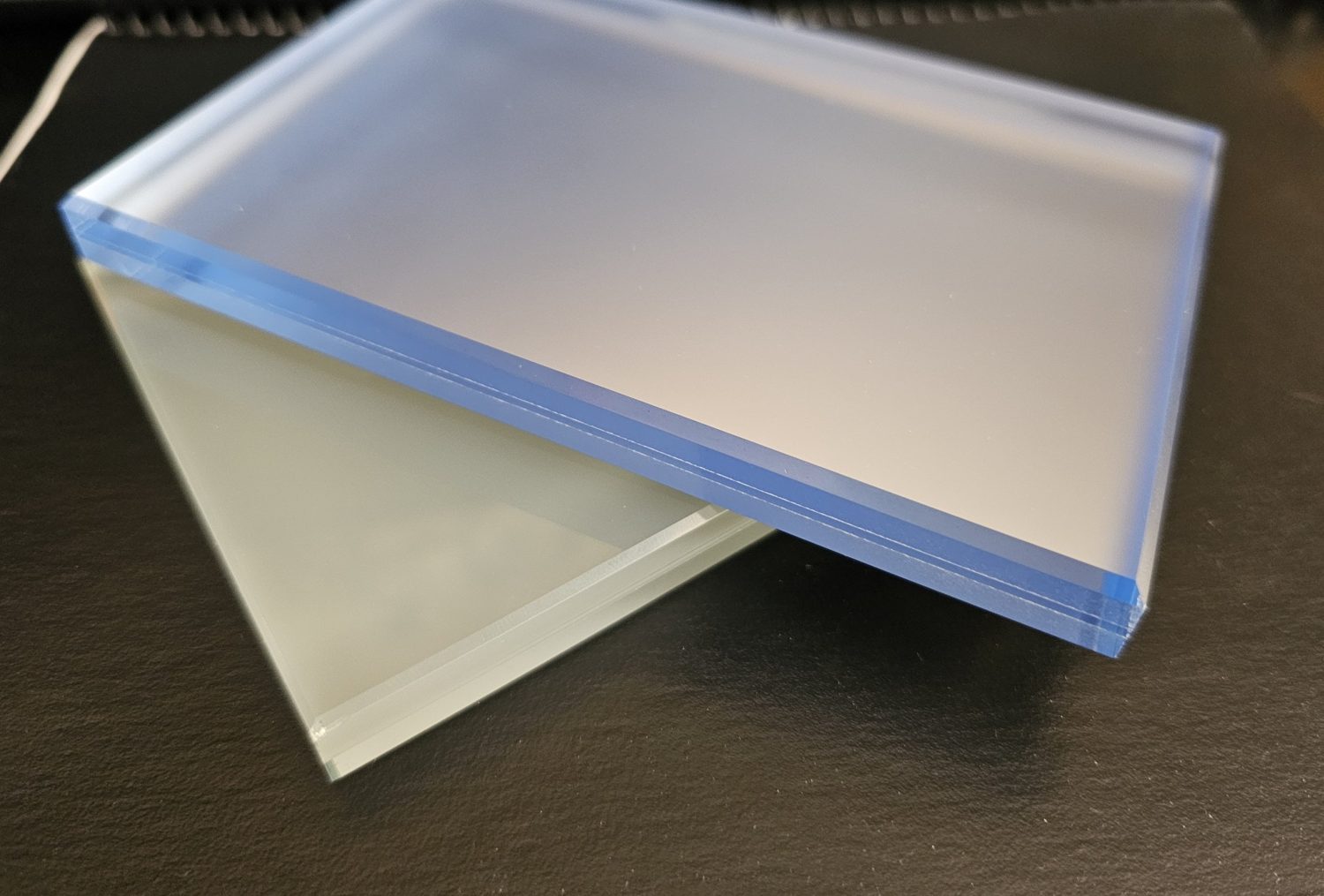
Look at the face of the blue sample and the color is quiet: a pale, icy blue, soft as fog. Look at its edge and the same glass turns vivid. That change is the first thing everyone notices, and it is the reason the sample was made.
The piece is laminated glass, built from two lites of blue glass. The back lite is a mirror. The front lite has a velour surface. The two are bonded face to face into a single panel, so the mirror is not something added on site: it is already inside the glass.
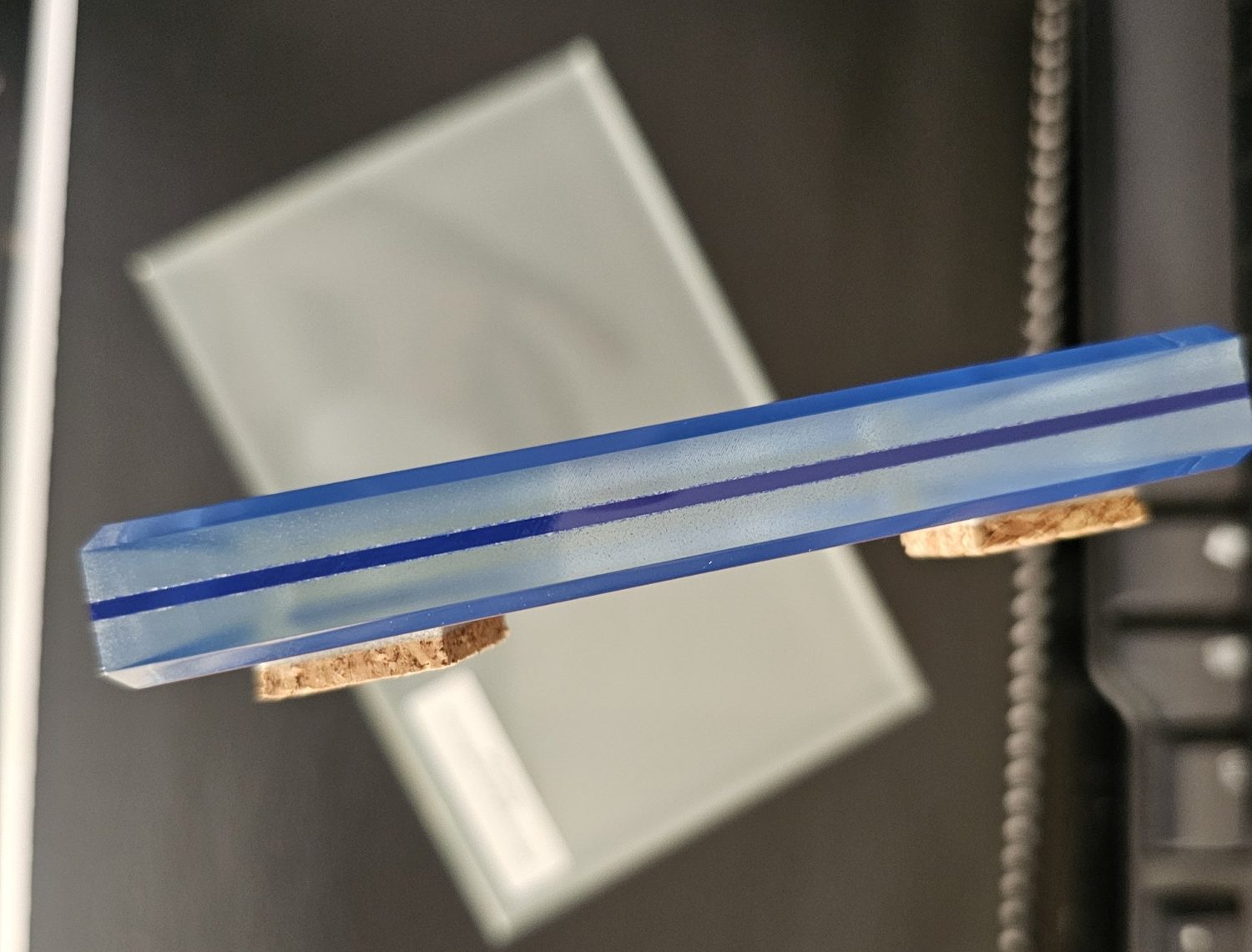
Velour is the right word for the surface. It is finer and softer than ordinary frosting, closer to fabric than to sandblasted glass, and it feels like velvet under the hand. It turns reflection into glow, and fingerprints all but disappear on it. The color is in the glass itself, not painted on and not a film, so there is nothing on the surface to scratch or wear away.
A mirror you cannot see yourself in sounds like a contradiction. Here it is the whole idea.
The wall stops looking like a surface and starts looking like a depth.
Here is why. Light enters through the velour face and passes through the blue. It reaches the mirror and is sent back, passing through the blue a second time. The color you see has made the journey twice, so it is deeper and richer than the same glass against a plain wall. And because the velour face scatters the light, you never see a sharp reflection of yourself or the room. You see light held inside the glass, with no clear point where it ends.
People reach out to touch it, because the eye reads distance where the hand finds a flat panel. It is the effect of looking into deep water. A painted wall gives you color; this gives you color with space behind it.
Because the mirror is bonded in at the factory, there is no gap behind the glass to gather dust or moisture, nothing to line up during installation, and the look you approve in the sample is the look you get on the wall.
The second sample is clear glass with a frosted surface. On its own it reads as a soft white, with the faint green that ordinary clear glass always carries in its thickness. Nothing is added to it: no tint, no interlayer color. The frosting does the work, scattering light evenly so that the panel appears lit from within. See frosted glass and acid-washed glass for how that surface is made.
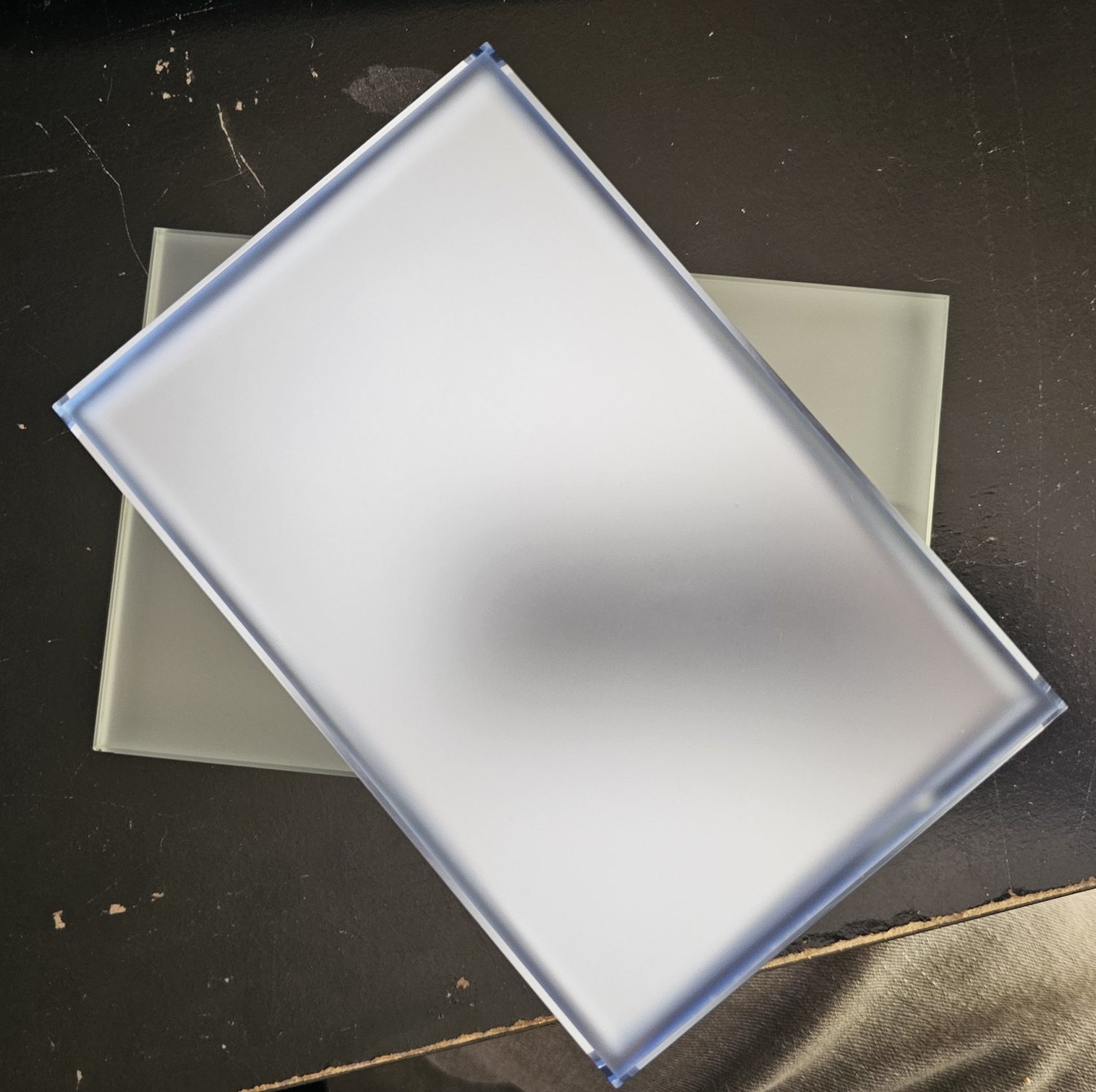
Its job in the scheme is contrast. Put the white beside the blue and each makes the other stronger: the blue looks deeper, the white looks cleaner. One panel recedes and the other comes forward, so a flat wall gains the look of layers. Where the two overlap, as in the photograph, a third tone appears, cooler than either.
A sample costs little and takes days. A wall of the wrong glass costs a great deal and cannot be returned, because architectural glass is made to order.
Feature walls in lobbies and reception areas. Elevator surrounds. Bar fronts and back-bar walls. Bathroom and spa walls. Partitions where privacy matters but daylight should still pass. Stair and corridor walls that would otherwise be a long, flat run of paint. Anywhere a designer wants color that changes through the day instead of sitting still.
The blue is one choice among many. Glass and mirror come in other colors, and colored interlayers widen the range further; the surface can be velour, satin or a heavier frost; clear glass can be standard or low-iron for a whiter white. The mirror behind can be clear, colored or a gray mirror. See also tinted glass and mirrors.
Once the samples are approved, the same make-up is ordered at full size. The edges are finished to suit, the fixing method is chosen for a panel that has a mirror inside it, and any holes or notches are decided before the glass is made, because a finished panel cannot be altered on site. We will add photographs here when the panels are in place.
If you have a wall that deserves better than paint, ask us for samples. Seeing two pieces of glass on your own table, in your own light, is the fastest way to decide.
Two lites of blue glass laminated into one panel: a blue mirror at the back and a blue glass with a velour surface in front. The mirror is bonded in at the factory.
Glass with a very fine, soft matte surface, smoother than ordinary frosting and velvety to the touch. It diffuses light, softens reflections and hides fingerprints.
Light passes through the color, reflects off the mirror and passes through the color again, so the tone is richer. With a velour or frosted face there is no sharp reflection, only a glow that seems to have depth.
Frosted glass is clear glass with a surface treated to scatter light, which makes it read as soft white while still letting light through. It has no pigment in it.
Yes. We arrange samples of the actual make-up, color and surface finish so that you can check them in the light of the room before full-size glass is made.
Feature walls, lobby and elevator surrounds, bar fronts, bathroom walls, partitions, and other interior surfaces. For each location the glass is specified as safety glass where required.
Architectural Glass Laminated Glass Frosted Glass Acid-Washed Glass Mirrors Gray Mirror All News
About this page. Written by Alex GC Inc. d/b/a Alex Glass Construction and reviewed before publication by Aleksandr Chernovolenko, Managing Partner, with our design and estimating lead and a field foreman. Our foremen hold the NYC DOB Site Safety Training supervisor card and our crews the 40-hour worker card; we are certified to fabricate, install and service Alutech and Everest aluminum systems. Facts are drawn from our own projects, manufacturer test data and the applicable codes; where we are giving an opinion, we say so. Last reviewed September 2026. Credentials
Tell us the room, the wall and the color you have in mind. We will arrange samples you can look at in your own light, then quote the full-size glass.