The sticker on a new window is three certifications in one. Line by line from a Marvin Ultimate wood double-hung we installed this week: what the glass make-up means, why U-factor should be low and visible transmittance high, why SHGC has no single right answer, what LC-PG50 and 50 psf say about wind, and why this window is ENERGY STAR in Texas but not in New York.
In short: The sticker on a new window is three labels in one: an ENERGY STAR map, an NFRC energy label and a WDMA (or AAMA) performance label. The four numbers that matter most are U-factor (heat loss; lower is better), solar heat gain coefficient (sun heat let in; lower is better for cooling, higher for free winter heat), visible transmittance (daylight; higher is better) and design pressure (wind strength; higher is better). The label in the photograph, from a Marvin Ultimate wood double-hung we installed this week, reads U 0.28, SHGC 0.17, VT 0.40 and DP ±50 psf. Below, every line on it explained, what the number means for a New York building, and which way is the good way for each one.
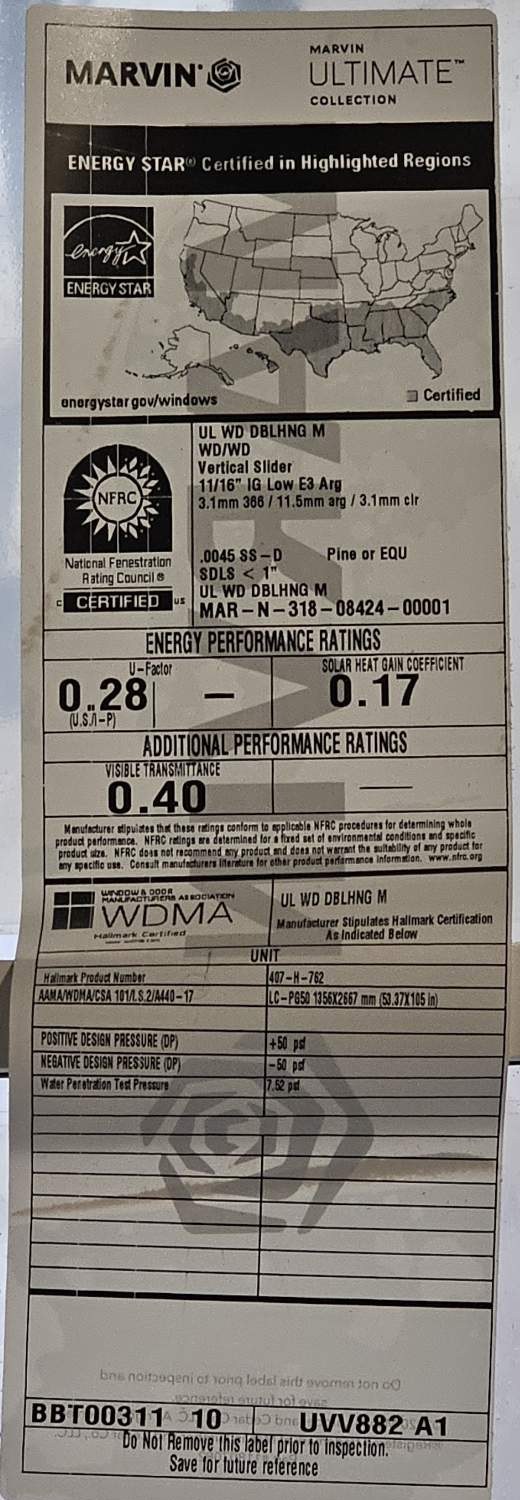
Every window sold in the United States with an NFRC rating carries a temporary label like this on the glass. It is removed after inspection and lost, which is a pity, because it is the only place where the glass make-up, the energy numbers and the structural rating are printed side by side. Read from the top:
The map at the top shows the ENERGY STAR climate zones in which this exact window qualifies. ENERGY STAR is not a single standard; it sets a different U-factor and SHGC limit for the Northern, North-Central, South-Central and Southern zones, and a window qualifies zone by zone. On this label the highlighted states are in the south and southwest. New York is in the Northern zone, and this window is not ENERGY STAR certified here. That is not a defect: the current Northern limit (version 7.0, in force since late 2023) asks for a U-factor of 0.22 or lower, which in a wood double-hung means triple glazing or a very specialized double unit. A U-factor of 0.28 meets the New York City energy code for a replacement window comfortably; it just does not earn the ENERGY STAR mark in this zone. If a rebate or a specification requires ENERGY STAR for New York, the map is where to check, not the logo.
The National Fenestration Rating Council is the independent body whose procedure every manufacturer uses to get comparable numbers. The block beside the NFRC logo describes the test specimen, and it is worth reading because the numbers below apply only to this configuration:
| Line on the label | What it means |
|---|---|
| UL WD DBLHNG M | Marvin's product code: Ultimate line, wood, double-hung, a size class. The NFRC certificate number at the bottom of the block (MAR-N-318-08424-00001) identifies the exact listing in the NFRC database. |
| WD/WD | Frame and sash material, outside and inside: wood and wood. A clad window would read AL/WD. |
| Vertical Slider | NFRC's name for a double-hung or single-hung: the sash slides vertically. |
| 11/16″ IG Low E3 Arg | The insulated glass unit: 11/16 inch thick overall, a third-generation (triple-silver) low-E coating, argon-filled. |
| 3.1 mm 366 / 11.5 mm arg / 3.1 mm clr | The make-up, outside to inside: a 3.1 mm lite carrying the "366" low-E coating, an 11.5 mm argon space, a 3.1 mm clear lite. "366" is the industry shorthand for a triple-silver coating that passes 66% of visible light and blocks most solar heat. |
| .0045 SS–D | The spacer between the two lites: a stainless steel, dual-seal spacer, with its thermal value as the lab lists it. See warm-edge spacer. |
| SDLS < 1″ | Simulated divided lites under 1 inch wide are on the glass. Grids change the rating, so the label says they were included; a unit without grids would rate slightly better on U-factor and VT. |
| Pine or EQU | The wood species tested, pine, or an equivalent. A different species does not change the glass numbers but is declared. |
The lesson from this block: an NFRC rating is for a specific glass make-up in a specific frame with specific grids. The same Marvin Ultimate double-hung with a different coating, no grids or a clad frame carries a different label. When comparing two quotes, compare the make-up lines first; a lower U-factor on one quote may just be a different glass.
This is the part people photograph. Four boxes, two of them filled in here, and the direction of "good" is different for each:
| Rating | This window | Better is… | What it measures |
|---|---|---|---|
| U-factor | 0.28 Btu/hr·sq ft·°F | Lower. 0.30 is the usual code ceiling; 0.28 is good double glazing; 0.20 and below is triple. | How fast heat escapes through the whole window, frame and glass together, in winter. It is the inverse of R-value: 0.28 is about R-3.6. This is the number that sets the heating bill and the condensation risk on a cold night. See U-factor. |
| SHGC | 0.17 | Depends. Lower blocks summer sun; higher lets winter sun warm the room. For a New York apartment with air conditioning, 0.25 to 0.40 is the usual range; 0.17 is a strongly sun-blocking glass. | The fraction of the sun's heat that gets through. 0.17 means 17% of the solar heat on the glass enters the room. The code limit for our climate is 0.40; this glass is well under it, which is why the window shows up ENERGY STAR in the South. See SHGC. |
| Visible transmittance | 0.40 | Higher. Clear double glazing is around 0.70; a good low-E around 0.50 to 0.60; the grids pull it down. | How much daylight comes through the whole window, including the frame, sash and grid bars. 0.40 looks low for a 366 coating because the rating counts the pine frame and the divided-lite bars as opaque area. The glass alone passes about 65%. |
| Air leakage | — (not rated) | Lower. 0.3 cfm/sq ft is the code maximum; 0.1 or less is a tight window. | Air through the closed window under a 25 mph wind. This box is optional on the NFRC label and Marvin left it blank here; the air leakage test is instead part of the WDMA certification below. |
| Condensation resistance | not shown | Higher. Scale 1 to 100. | Some labels carry a fifth box. Higher numbers resist fogging on the inside of the glass on cold days. |
So the two numbers people read as "efficiency" point in opposite directions. A window with U 0.28 and SHGC 0.17 is an excellent winter insulator and a strong sun blocker; it is also a slightly darker window than its clear-glass neighbor, and in a north-facing room with no cooling you might prefer an SHGC of 0.40 and the free heat. There is no single best; there is the right glass for the elevation. Our low-E glass page sets the common coatings side by side.
The lower third is a different certification by a different body: the Window and Door Manufacturers Association, whose Hallmark program tests the window to the North American Fenestration Standard, AAMA/WDMA/CSA 101/I.S.2/A440, the 2017 edition here. The NFRC label says how the window handles heat and light; this one says how it handles wind and water.
| Line on the label | This window | Better is… | What it means |
|---|---|---|---|
| Hallmark product number | 407-H-762 | — | The certification listing for this product; the auditor checks it against the factory. |
| Performance class and grade | LC-PG50 | Higher grade. R-PG15 is a minimum residential window; LC-PG50 is light commercial; CW and AW are heavier classes. | LC is the Light Commercial class; PG50 means the window passed the full test series at a design pressure of 50 pounds per square foot. |
| Tested size | 1356 × 2667 mm (53.37 × 10⁵ in) | Larger. The rating applies to this size and smaller. | The largest unit that carries this grade. A 53 by 105 inch double-hung is a big one; anything smaller in the same line is covered. |
| Design pressure | +50 / −50 psf | Higher. NYC low-rise walls typically need 25 to 40 psf; corners and upper floors more. | The wind pressure, pushing in (positive) and sucking out (negative), the window is rated to carry in service; it is proof-tested at 1.5 times that, 75 psf. 50 psf corresponds to a wind of roughly 140 mph in open terrain. Whether it is enough is decided by the building's wind load calculation, not by the label. |
| Water penetration test pressure | 7.52 psf | Higher. | The pressure at which the window was sprayed with water for the leak test, by rule 15% of the design pressure. 7.5 psf is a wind of about 55 mph with 8 inches of rain an hour; the window passed with no water past the inner face. |
The structural label is the one owners never ask about and should. Two windows with identical U-factors can be an R-PG15 and an LC-PG50, and on an exposed upper floor in Brooklyn the first will pump and leak in a nor'easter while the second will not.
When you have two quotes, put the labels side by side and read in this order. First the make-up line, so you know you are comparing the same glass. Then U-factor, lower wins, and ask whether the difference is the glass or the frame. Then SHGC, and decide which way you want it for that elevation; south and west windows in a cooled apartment want it low, north windows do not care, a sunroom may want it high. Then VT, higher wins, remembering that grids and heavy frames pull it down. Then the WDMA line: class, grade and tested size, higher and larger win, and the grade must meet the wind load for your floor and exposure. Price last. A window that wins on all five is rare; a window that wins on the two that matter for your opening is what we are trying to sell you.
We supply and install Marvin, Pella and Andersen windows and read these labels for a living; if you send us a photo of yours we will tell you what it says. Marvin windows · double-hung windows · request a quote.
0.30 or lower meets the energy code for a replacement window; 0.25 to 0.28 is good double glazing with a low-E coating and argon; 0.22 or lower, usually triple glazing, is what ENERGY STAR now requires in the Northern zone, which includes New York.
It depends on the room. Lower SHGC blocks solar heat, which is what an air-conditioned apartment with south or west windows wants. Higher SHGC lets winter sun in, which suits a north-facing or unconditioned room. The code limit in New York City is 0.40.
Because the NFRC rates the whole window, frame and grid bars included. A 366 coating passes about 65% of light through the glass, but a wood double-hung with divided-lite bars has a lot of opaque area, so the whole-window figure drops to around 0.40.
Light Commercial performance class, performance grade 50: the window passed air, water and structural tests at a design pressure of 50 psf, with a structural proof test at 75 psf, at the size printed next to it. Higher grades carry more wind load.
ENERGY STAR certifies by climate zone. New York is in the Northern zone, where the current limit is a U-factor of 0.22. A window at 0.28 can qualify in the South-Central and Southern zones, as the map on the label shows, and still meet the New York energy code.
Air leakage is optional on the NFRC label. Manufacturers who certify through WDMA or AAMA test air leakage there instead; a PG-rated window has passed an air leakage test of 0.3 cfm per square foot or better.
Not before the inspection: the inspector reads it. After sign-off, photograph it and keep the serial number for warranty claims, then remove it.
1530 Bergen Street, Crown Heights: aluminum tilt-and-turn windows Low-E glass: hard vs soft coat, U-value and SHGC Glossary: U-factor Glossary: SHGC Glossary: NFRC Why you need a wind load calculation Marvin windows Double-hung windows
About this page. Written by Alex GC Inc. d/b/a Alex Glass Construction and reviewed before publication by Aleksandr Chernovolenko, Managing Partner, with our design and estimating lead and a field foreman. Our foremen hold the NYC DOB Site Safety Training supervisor card and our crews the 40-hour worker card; we are certified to fabricate, install and service Alutech and Everest aluminum systems. Facts are drawn from our own projects, manufacturer test data and the applicable codes; where we are giving an opinion, we say so. Last reviewed November 2026. Credentials
Send us a photo. We will tell you what the window is, how it rates for your floor and exposure, and whether it meets the code and the spec.