The film on an aluminum composite panel is made for the shop and the truck, not for a season on a facade. What sun and heat do to it, why a dried film is no longer one piece, what it costs the owner in labor, residue and ghosting, and the rule we follow on every panel job: strip each elevation before the lift moves on.
In short: Aluminum composite panels arrive with a thin polyethylene film on the finished face. It is there to protect the paint through fabrication, shipping and installation, and it is meant to come off the day the panel goes up, or at the latest within the window the panel maker prints on the sheet. Leave it in the sun and two things happen: the film dries and goes brittle, and the adhesive under it cures onto the paint. From then on the film is no longer one sheet that peels in a single pull; it tears into pieces, leaves adhesive behind, and the panel underneath weathers differently where it was covered. The photograph below is a parapet cap we stripped on a Brooklyn roof this week: film that should have taken a minute per panel came off in shreds, by hand, piece by piece. Our rule is simple: the film comes off as each elevation is finished and signed off, before the crew leaves, and the closeout photos show bare panel.
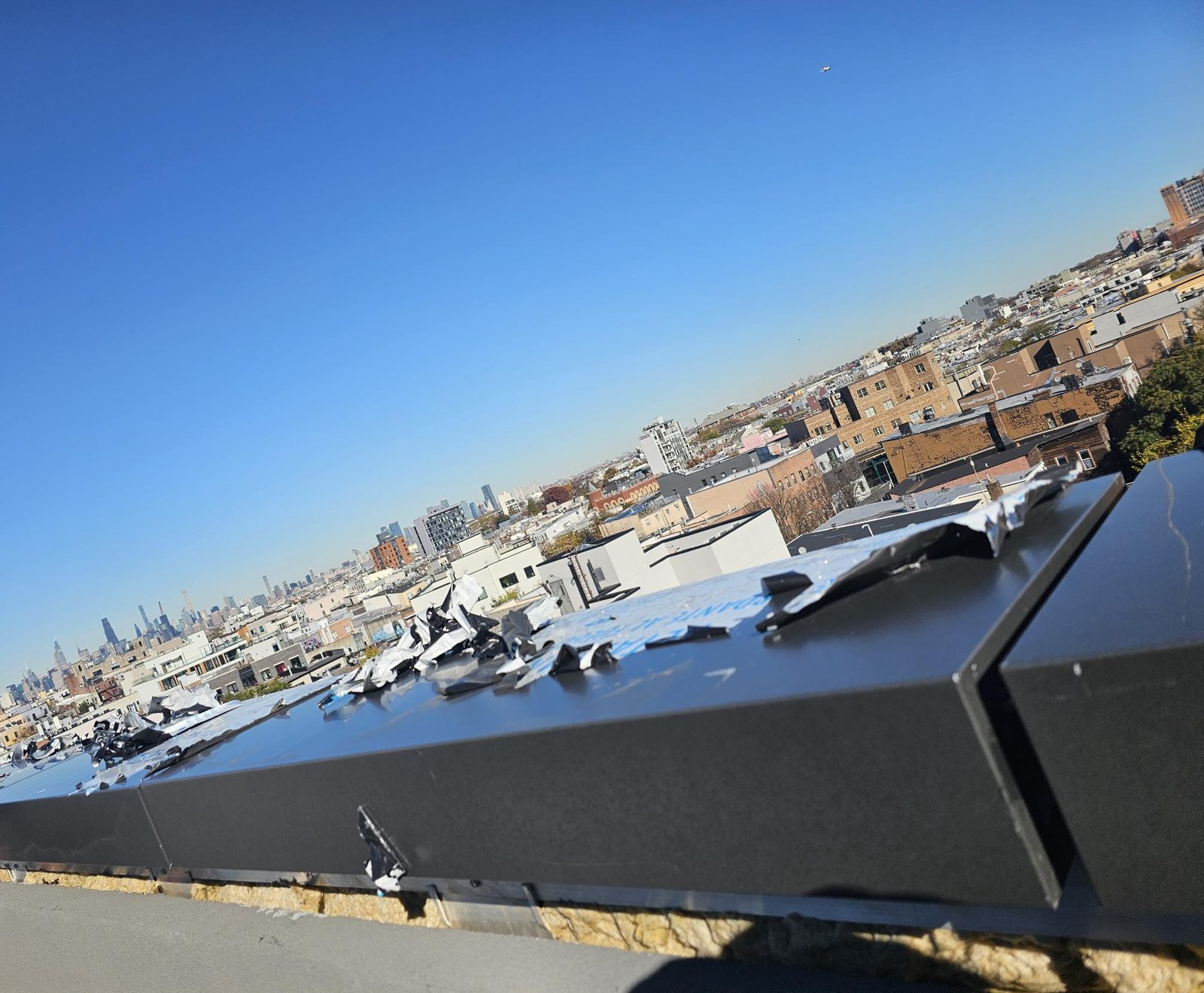
The protective film is a two-layer product: a polyethylene carrier, usually white or blue with the maker's printing on it, and a low-tack adhesive on the back that is designed to hold during handling and release cleanly. Both layers are rated for a limited time outdoors. Ultraviolet light breaks the polymer chains in the carrier until it loses its stretch; heat on a dark panel, which can reach 150°F or more on a summer roof, cures the adhesive from a soft, removable layer into a hard one bonded to the paint. The two changes happen together, and the result is what you see above: the carrier snaps instead of stretching, and the adhesive stays on the panel instead of leaving with the film.
Panel makers put a number on it. Most state that the film must be removed within a set period after installation, commonly measured in weeks, and never later than a set number of months after the panel was produced, whichever comes first. The numbers differ between brands and are on the data sheet and often printed on the film itself. They are not generous, because the film was designed for the shop and the truck, not for a season on a facade.
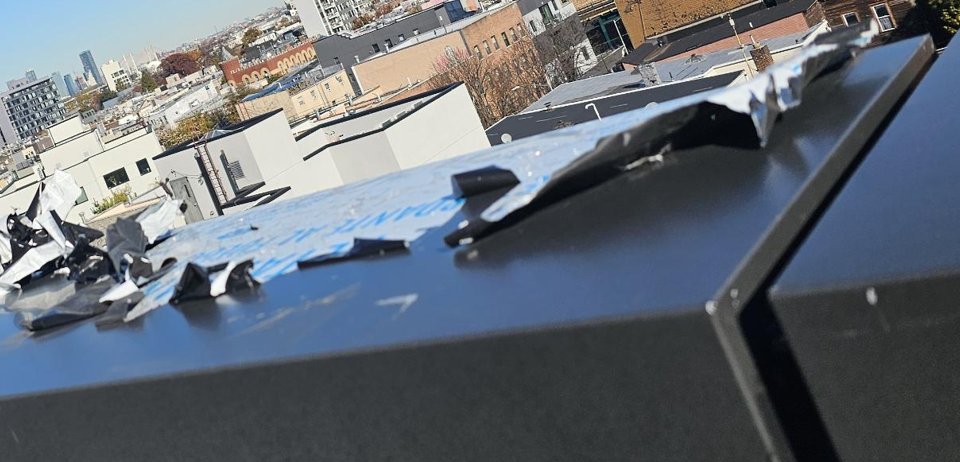
An installer describes the failure in one sentence: the film dries, and after that it is not a single piece. On a fresh panel you lift one corner and the whole sheet comes away in a pull, with the adhesive on it. On a dried panel the corner comes away as a chip the size of a coin, the next pull takes another chip, and the adhesive stays behind as a tacky haze or, worse, as a pattern that follows the printing on the film. A panel that takes sixty seconds to strip on installation day takes twenty minutes a month later, on a lift, with a plastic scraper and a solvent approved by the paint maker, and the result is still not as clean as it would have been on day one.
The failure is not even across a facade. Parapet caps and copings, which face the sky all day, go first. South and west elevations go next. Dark colors, which run hotter, go before light ones. Panels under a canopy or on a north wall may still peel cleanly months later, which is why owners sometimes assume the film is fine everywhere because it was fine on the one panel they tried.
None of this is a panel defect. It is a schedule failure, and it is why the film comes off while the installer is still on the wall.
The same rule applies to windows, doors and storefront framing, which ship with film on the aluminum; the general case is covered in remove protective film right after installation. This article is the ACM-specific version because panels are the product where the damage is largest: more area, more sun, and a painted finish that cannot be re-anodized.
Check a cap or a south-facing panel first. If a corner lifts and the sheet follows, strip the facade now, in one pass, before the next sunny week. If the corner snaps off, stop pulling, photograph it, and call; the removal method changes, and so does the conversation with the panel maker about the finish. For the panels themselves and how a facade is built, see aluminum composite panels and rain screen systems; for our recent ACM work, a cornice and parapet system in progress and the Fresh Meadows canopy and facade. To have film removed, or panels installed with the film handled properly, request a quote.
On the day the panels are installed, section by section, and never later than the window the panel maker prints on the data sheet, which is measured in weeks after installation and months after production.
Ultraviolet light makes the polyethylene carrier brittle and heat cures the adhesive onto the paint. The film stops behaving as one sheet and breaks off in chips, leaving adhesive behind.
Parapet caps, copings and sills that face the sky, then south and west elevations, and dark colors before light ones. A north-facing panel can still peel cleanly when a cap on the same building has already dried.
The film itself does not, but cured adhesive and the cleaners needed to remove it can dull or strip a painted finish, and paint under the film weathers differently from paint that was exposed on time, which shows as ghosting.
By section, on a warm day, with plastic scrapers and a cleaner the paint manufacturer approves for the finish, tested on a hidden area first. No metal tools and no unapproved solvents.
Film left past the manufacturer's removal window is the most common reason a finish claim is refused. The window is in the installation instructions.
Yes. Each elevation is stripped as it is completed and signed off, before the crew leaves it, and closeout photographs show bare panel.
Remove protective film right after installation Aluminum composite panels Rain screen systems ACM panels vs brick facade Cornice and parapet ACM system Fresh Meadows ACM canopy and facade
About this page. Written by Alex GC Inc. d/b/a Alex Glass Construction and reviewed before publication by Aleksandr Chernovolenko, Managing Partner, with our design and estimating lead and a field foreman. Our foremen hold the NYC DOB Site Safety Training supervisor card and our crews the 40-hour worker card; we are certified to fabricate, install and service Alutech and Everest aluminum systems. Facts are drawn from our own projects, manufacturer test data and the applicable codes; where we are giving an opinion, we say so. Last reviewed November 2026. Credentials
Check a cap or a south-facing panel. If the corner snaps instead of peeling, stop and send us a photo; the removal method changes.