A client wants a free-standing storefront with 157-inch lites in 6+6 laminated glass, captured top and bottom only. Here are the three limits that apply and the options that work.
In short: A client asked us for a storefront with glass 4,000 mm (157 inches) tall in 1/2-inch (6+6) laminated glass, held only at the top and the bottom. Three separate limits apply: the sheet size most fabricators stock (the long dimension is usually 130 to 144 inches), the deflection of a lite spanning 4 m between two supports, and the weight and handling of a lite that size. Our estimate: 1/2-inch glass captured top and bottom only cannot span 4 m; captured on all four edges in a framed storefront, the same 1/2-inch laminated glass works. Below is the arithmetic and the options.
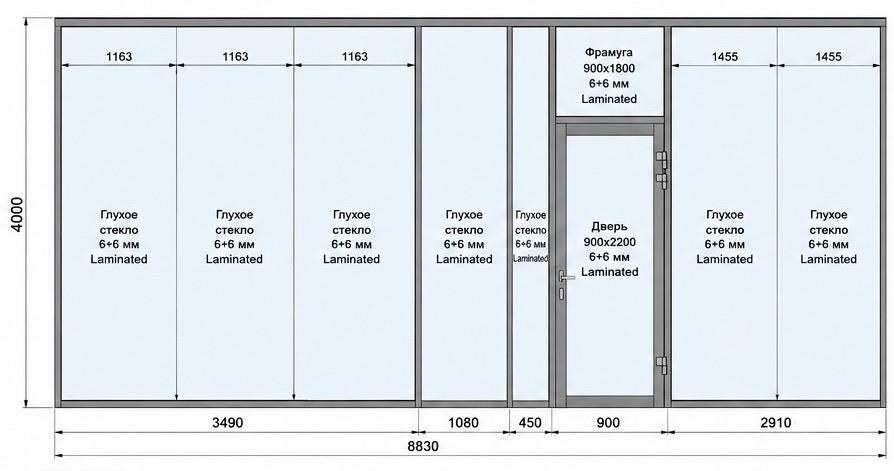
The drawing shows an opening 8,830 mm wide by 4,000 mm high: three fixed lites of 1,163 mm, a 1,080 mm lite, a 450 mm lite, a 900 × 2,200 mm door with a 900 × 1,800 mm transom over it, and two fixed lites of 1,455 mm. Every lite is specified as 6+6 mm laminated (about 1/2 inch), and the glass is drawn free-standing: channels at the floor and at the head, no vertical framing between lites, with butt joints between panels. The look is a clean wall of glass. The question is whether it can be built as drawn.
Float glass is made in standard sheets. The sizes most glass shops and storefront fabricators keep in stock, in clear and laminated, have a long dimension of 130 inches (3,300 mm), and some carry 144 inches (3,658 mm). Our own stock list on the Gallery shows 72 × 96 and 84 × 130 inches for most glass. A 157-inch lite does not come out of any of those sheets.
It does exist. The industry's “jumbo” sheet is nominally 130 × 204 inches (3,300 × 5,180 mm), and a handful of specialist fabricators temper and laminate at that size and larger: one West Coast fabricator publishes tempered monolithic up to 130 × 268 inches and laminated up to 130 × 300 inches. So a 1,163 × 4,000 mm laminated lite can be made, but it is a jumbo special order from a jumbo fabricator, not a sheet cut in a local shop: longer lead time, freight on an A-frame, a higher price per square foot, and a crane or vacuum lifter at the site. If one lite breaks later, the replacement is the same special order.
Width is not the problem. All of the lites on the drawing are 1,455 mm (57 inches) or narrower, well inside any sheet. It is the 4,000 mm height that pushes the order into jumbo territory.
This is the limit that decides the job. Glass held at two opposite edges behaves as a beam spanning between them. A lite captured in a channel at the floor and at the head spans the full 4,000 mm, and deflection under load grows with the fourth power of the span: double the span and the deflection goes up sixteen times. Glass captured on all four edges in a storefront frame, by contrast, spans the short way across its width, 1,163 mm here, and is many times stiffer.
The table gives our estimate of mid-height deflection for a 4,000 mm two-edge span under a uniform load, using simple beam theory for a strip of glass. The usual deflection limit for glazing is span over 175, which for 4,000 mm is 23 mm (0.9 inches). The 5 psf column is the minimum interior partition load most codes require; the 20 and 25 psf columns are the range of design wind pressure a ground-floor exterior storefront in New York City sees, depending on exposure and height, with the exact number set by the engineer for the building.
| Glass (two-edge support, 4,000 mm span) | 5 psf (interior) | 20 psf (exterior) | 25 psf (exterior) |
|---|---|---|---|
| 1/2" laminated, 6+6 PVB, plies acting separately (long-term or warm) | 320 mm | 1,270 mm | 1,580 mm |
| 1/2" laminated behaving as one 12 mm lite (SGP interlayer, or PVB under a short gust) | 79 mm | 320 mm | 400 mm |
| 3/4" (19 mm) laminated, SGP | 20 mm | 80 mm | 100 mm |
| 1" (25 mm) laminated, SGP | 9 mm | 35 mm | 44 mm |
| 1-1/4" (32 mm) laminated, SGP | 4 mm | 17 mm | 21 mm |
| Limit, span/175 | 23 mm | 23 mm | 23 mm |
The numbers for 1/2-inch glass are not a close call. Even in the best case, with an ionoplast (SGP) interlayer that makes the two plies work as one, the 4 m lite deflects about 79 mm under the minimum interior load and well over 300 mm under storefront wind, which is three to fifteen times the limit, and the bending stress at the higher loads exceeds what laminated glass can carry. Those large figures are beyond what simple beam theory can describe exactly, but the conclusion does not change: 1/2-inch glass on two edges does not span 4 m. With a standard PVB interlayer it is worse, because under a sustained load or in summer heat the two 6 mm plies slide on the interlayer and act as two thin sheets, which is why a 1/2-inch laminated lite that looks stiff when you lift it still bows in the opening.
For an interior partition, free-standing glass this tall needs roughly 3/4-inch SGP laminated glass to meet span/175. For an exterior storefront on two edges it needs 1-1/4 inch or more, which no one builds; the industry answer is to add a third support.
Laminated glass weighs about 2.5 kg per square meter for every millimeter of thickness. A 1,163 × 4,000 mm lite of 6+6 laminated is 4.65 m² and weighs about 150 kg (330 lb); the 1,455 mm lite is about 185 kg (410 lb). At 3/4 inch those become 230 and 290 kg. Lites of that size and weight go in with a vacuum lifter on a crane or a glazing robot, not by hand, and the site needs room for an A-frame truck to park at the opening. None of this stops the job, but it changes the price and the schedule, and it is the reason the standard 130-inch sheet height exists: it is what two or four glaziers can set.
Whichever route the client chooses, the specification should name the interlayer. For tall, lightly supported glass, an ionoplast (SGP) interlayer is worth the premium over PVB because it keeps the two plies working together under heat and sustained load; see SGP laminated glass and laminated glass.
The deflections above are our estimates from simple beam theory, for comparison between options; they are not a design. Glass design in New York is done to ASTM E1300 and the building code by an engineer, who sets the wind pressure for the site, checks stress as well as deflection, and takes the actual edge support into account. We provide the drawings and the glass data for that calculation on every job of this kind, as we did on the Flatbush Avenue storefront and the 24 Frost Street curtain wall.
The practical limit is the sheet most fabricators stock: a long dimension of 130 inches, sometimes 144 inches. Jumbo glass up to about 130 by 204 inches is standard at specialist fabricators, and a few go to 130 by 300 inches laminated. Above the stock size the glass is a special order with crane setting.
No. Our estimate puts the deflection at 79 mm even under the minimum interior load with an SGP interlayer, against a limit of about 23 mm, and far more under storefront wind. It needs four-edge support, glass fins, or much thicker glass.
Because under sustained load or heat the two plies slide on a PVB interlayer and act as two 6 mm sheets, not one 12 mm sheet. An ionoplast (SGP) interlayer keeps them working together, but even then 1/2 inch is far too thin for a 4 m two-edge span.
Span divided by 175 is the usual limit for glazing in aluminum framing; some interior work accepts span over 100. For a 4,000 mm span that is 23 mm and 40 mm respectively.
Capture the glass on all four edges in a storefront or curtain wall frame, or support butt-jointed glass with vertical glass fins. Both let standard-thickness laminated glass be used.
About 150 kg (330 lb) for a 1,163 by 4,000 mm lite of 6+6 laminated, and about 185 kg (410 lb) at 1,455 mm wide. These are set with a vacuum lifter and a crane.
Storefront systems Frameless glass systems Laminated glass SGP laminated glass Glass types and specifications Glass weight calculator Storefront vs curtain wall Request a quote
About this page. Written by Alex GC Inc. d/b/a Alex Glass Construction and reviewed before publication by Aleksandr Chernovolenko, Managing Partner, with our design and estimating lead and a field foreman. Our foremen hold the NYC DOB Site Safety Training supervisor card and our crews the 40-hour worker card; we are certified to fabricate, install and service Alutech and Everest aluminum systems. Facts are drawn from our own projects, manufacturer test data and the applicable codes; where we are giving an opinion, we say so. Last reviewed September 2026. Credentials
Send the drawing and the opening size. We will tell you what sheet sizes and thicknesses are available, estimate the deflection, and propose the support that lets the glass work.