A nearly clear film for glass walls that turns every monitor, TV and video wall black to anyone looking in, while the people inside see their screens as usual. Now available supplied and installed on new or existing glass.
In short: We now offer cloaking film for glass partitions and office fronts. Applied to the glass, it is almost invisible, a light clear-grey tint, yet every LCD, LED or OLED screen behind it appears black to anyone looking in from outside the room. The people inside see their monitors, TVs and video walls exactly as before. It is the answer for conference rooms, trading floors, clinics, HR offices and any glass-walled room where the screen is the thing that should stay private. Supplied in 48- and 60-inch widths and installed by us on new or existing glass.
Glass offices are open by design: daylight through the whole floor, people visible, nobody shut in a box. The one thing that does not belong in that openness is the screen. A quarterly forecast on a conference-room display, a patient record on a clinic monitor, a trading screen, a candidate’s file in HR, a video call with a client: all of it is readable from the corridor through clear glass, and the usual fix, frosted film across the whole wall, kills the daylight and the openness that the glass was chosen for.
Cloaking film solves only that problem, and nothing else. It is a thin optical film that filters out the polarized light that flat-panel displays emit, so a screen seen through it goes black while everything else in the room, the people, the furniture, the daylight, is seen normally. Inside the room nothing changes. Think of it as a privacy screen that lives on the glass wall instead of on the monitor.
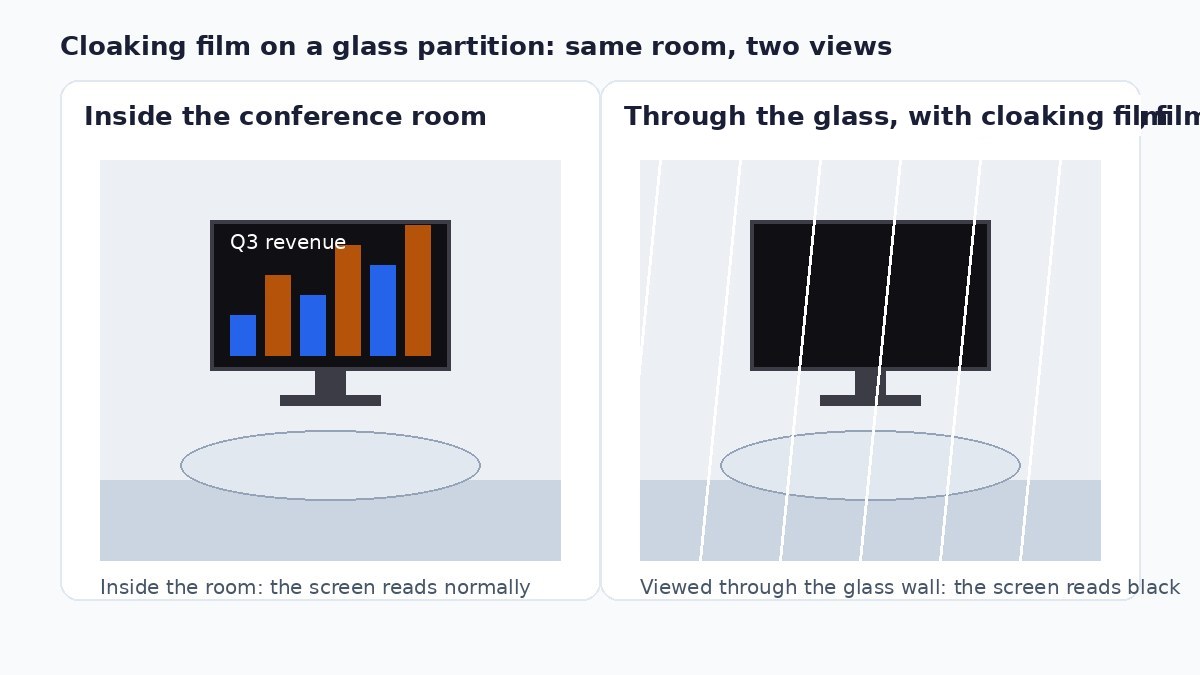
An LCD or LED display produces light that is polarized in one direction; the room’s ordinary light is not. Cloaking film is built with a polarizing layer set to block that one orientation. Light from the screen is stopped; light from everything else passes. That is why the screen reads as black rather than blurred, and why the film can stay almost clear: it does not need to obscure the view, only one specific kind of light.
Two things to know. The film is directional: it is made for screens mounted in the standard landscape orientation and is applied in the standard vertical orientation. A screen rotated to portrait may show through, so we confirm the screen layout before we cut the film. And it is a one-way effect only in the sense that it blocks the screen; it does not make the glass a mirror or hide the people inside.
| Use | Architectural glass film for partitions, office fronts, conference rooms, storefront glass |
| Compatibility | LCD, LED and OLED displays |
| Roll width | 48 in and 60 in |
| Roll length | 100 ft |
| Visible light transmission | About 43% |
| Haze | Under 1% |
| Cloaking efficiency | 99.95% |
| Color | Clear grey |
| Thickness | 0.006–0.007 in |
| Construction | PET, triacetate and polyvinyl layers, acrylic pressure-sensitive adhesive |
| Surface | Scratch-resistant; hard-coat option |
| UV rejection | 75% or more |
| Infrared rejection | Under 12% (this is not a solar-control film) |
| Service temperature | 23°F to 140°F; tested to −22°F to 176°F |
| Fire tests | ASTM E84 Class A; EN 13501-1 C-s2,d0 |
| Compliance | REACH SVHC, RoHS; VOC CA 01350 |
| Warranty | 60 months |
Figures are from the manufacturer’s data sheet. Because the film is thin and nearly clear, it can be combined with a band of frosted film at eye level where a room needs both screen privacy and some visual privacy.
We install it on the glass office partitions we build, on existing partitions and on exterior glass. The Sheepshead Bay office partitions and the Newark Public Library research rooms are the kind of glass it is made for.
The film is applied to the glass on the side facing the viewer who should not see the screen, usually the corridor side of a partition. The glass is cleaned, the film is cut to the lite with the orientation set, applied wet, squeegeed and trimmed at the edge, and left to cure. On new partitions we apply it in the shop before the glass goes in; on existing glass it is a same-day job for a typical conference room. There is no wiring, no change to the screens, and the film can be removed later without damage to the glass.
Send us a photo of the room, the number and size of the glass lites, and where the screens are mounted. We will confirm the film will cover the sightlines, quote it supplied and installed, and, if the room also needs visual privacy, propose the frosted band to go with it.
A nearly clear optical film for glass that blocks the polarized light flat-panel screens emit. Looking through it, every LCD, LED or OLED screen appears black; the rest of the room is seen normally, and the people inside see their screens as usual.
No. It is a light clear-grey tint with about 43% visible light transmission and under 1% haze. It does not hide people or furniture; it hides screens only.
It works on LCD, LED and OLED displays mounted in the normal landscape orientation, which is what the film is cut for. Screens rotated to portrait may show through; we check the layout before installing.
Yes. It is applied to the corridor side of existing glass, usually in a day for a conference room, with no change to the screens or the partition.
No. It is an optical privacy film. For impact, forced-entry or safety performance, see our laminated and tempered glass pages.
Yes. A frosted band at eye level with cloaking film over the full lite gives both visual privacy and screen privacy without losing the daylight.
Glass partitions Frosted glass Tinted glass Sheepshead Bay office partitions Newark Public Library partitions Commercial doors Request a quote
About this page. Written by Alex GC Inc. d/b/a Alex Glass Construction and reviewed before publication by Aleksandr Chernovolenko, Managing Partner, with our design and estimating lead and a field foreman. Our foremen hold the NYC DOB Site Safety Training supervisor card and our crews the 40-hour worker card; we are certified to fabricate, install and service Alutech and Everest aluminum systems. Facts are drawn from our own projects, manufacturer test data and the applicable codes; where we are giving an opinion, we say so. Last reviewed September 2026. Credentials
Send a photo of the room, the glass sizes and where the screens are. We will quote the film supplied and installed, with a frosted band if the room needs it.