A low-E coating is one layer; the numbers belong to the whole unit. Here is what U-value, VLT, SHGC and STC mean, the same coating in four constructions from Vitro's data, Solarban 60 vs 70 vs 90 in a one-inch unit, which coating we used on four Brooklyn buildings and why, and how to read a glass data sheet.
In short: A low-E coating is only one layer of a glass unit, and the numbers on the data sheet belong to the whole unit, not the coating. The same Solarban 70 coating gives a U-value of 1.02 on a single pane, 0.28 in a standard double-glazed insulated unit, 0.15 in a triple, and 0.05 in a vacuum insulated unit 8 mm thick. Light transmission, solar heat gain and sound rating move with it, and not always in the direction you would expect: the triple lets in less light than the double, and the thin vacuum unit insulates four times better than the triple while blocking less sound. Below is what each number means, the four constructions side by side from Vitro's published data, how Solarban 60, 70 and 90 compare in the one-inch unit that goes into most of our storefronts and windows, and where we have used each one.
The data sheet also gives reflectance (how mirror-like the glass looks from outside and from inside) and a color rendering index, which is how true colors look through the glass; 100 is an open window. Those decide what the building looks like; the four above decide what it costs to heat and cool.
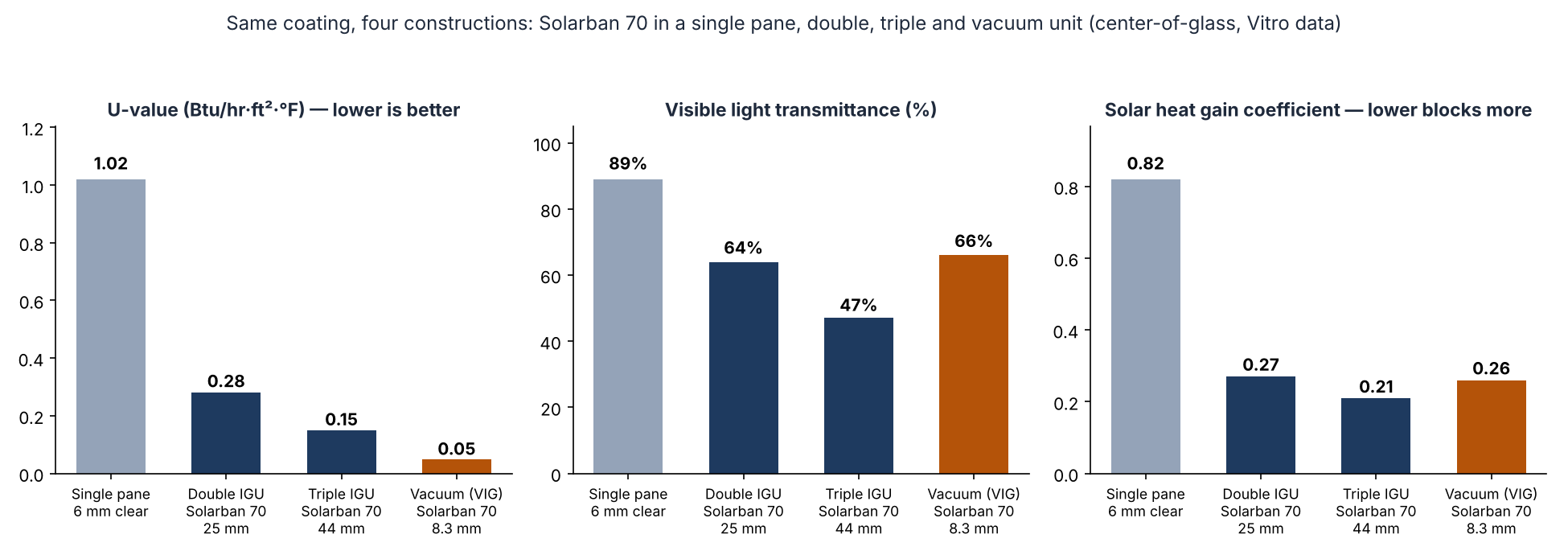
| 6 mm clear, single pane | Double IGU, Solarban 70 (2) + clear | Triple IGU, Solarban 70 (2) + clear + clear | VacuMax vacuum unit, Solarban 70 | |
|---|---|---|---|---|
| U-value | 1.02 | 0.28 | 0.15 | 0.05 |
| R-value | 1.0 | 3.6 | 6.7 | 20.0 |
| Visible light transmittance | 89% | 64% | 47% | 66% |
| Solar heat gain coefficient | 0.82 | 0.27 | 0.21 | 0.26 |
| STC / OITC | 32 / 29 | 34 / 29 | 40 / 32 | 27 / 30 |
| Seal strength | n/a | 150 psi | 150 psi | 3,000 psi |
| Overall thickness | 6 mm (1/4-inch) | 25 mm (1-inch) | 44 mm (1 3/4-inch) | 8.3 mm (about 5/16-inch) |
Reading across:
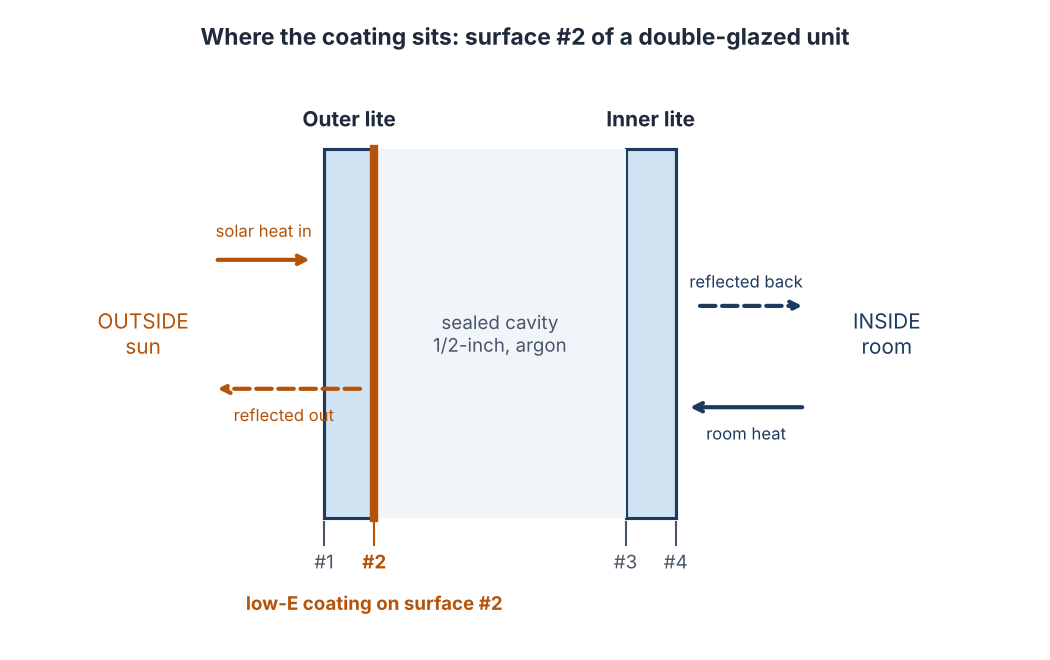
Most of what we glaze is a one-inch insulated unit: two 1/4-inch lites and a 1/2-inch cavity. For that unit Vitro publishes the following center-of-glass figures, with the coating on surface #2 and an argon fill:
| Make-up (1-inch unit, argon) | VLT | U-value | SHGC | Light-to-solar-gain | Exterior reflectance |
|---|---|---|---|---|---|
| Clear + clear, no coating | 79% | 0.45 | 0.70 | 1.1 | 15% |
| Solarban 60 (2) clear + clear | 70% | 0.24 | 0.39 | 1.8 | 11% |
| Solarban 65 (2) clear + clear | 70% | 0.24 | 0.35 | 2.0 | 14% |
| Solarban 70 (2) + clear | 64% | 0.24 | 0.27 | 2.4 | 13% |
| Solarban 90 (2) clear + clear | 51% | 0.24 | 0.23 | 2.2 | 12% |
| Solarban R100 (2) clear + clear | 42% | 0.25 | 0.23 | 1.8 | 32% |
| Solarban 70 (2) + Sungate ThermL (4) clear | 63% | 0.19 | 0.27 | 2.3 | 13% |
Three things stand out. First, every Solarban coating gives the same U-value in this unit, 0.24; the coating's emissivity is what sets it, and all of them are low. Second, what separates them is solar gain and light: Solarban 60 keeps 70 percent of the daylight and blocks 61 percent of the solar heat; Solarban 70 keeps 64 percent of the light and blocks 73 percent of the heat; Solarban 90 goes further on heat at the cost of a third of the light. Third, the only way to move the U-value in a double unit is a second coating on surface #4, the room-side face of the inner lite; Sungate ThermL there takes a Solarban 70 unit from 0.24 to 0.19 with almost no change in light or color. On a triple, Vitro's data gives Solarban 70 a U of 0.15 without it.
Appearance follows the numbers. Solarban 60 and 65 read close to clear; Solarban 70 is neutral with a faint cool cast and is the coating most often specified where the architect wants the glass to disappear; Solarban 90 and the R-series are visibly more reflective from outside. On a tinted outer lite (Solexia green, Optigray, Solarbronze, Pacifica) the same coating gives lower light and lower solar gain again; the data sheet lists every combination. We keep the samples at the showroom because the numbers do not show you the color.
The pattern is the one the numbers suggest: Solarban 60 on residential windows where the glass is a modest share of the wall and the view matters, Solarban 70 on large unshaded commercial glass where the cooling load is the problem. On a south or west storefront the difference between the two is about 12 points of solar heat gain for 6 points of light, and the mechanical engineer usually asks for the 70.
New York City is in climate zone 4A, and the energy code sets a maximum U-factor and a maximum SHGC for fenestration by building type and by whether the unit is fixed or operable, with the whole-window value (glass, spacer and frame together) being what is checked, not the center-of-glass figure on the data sheet. A Solarban double unit at 0.24 center-of-glass in a thermally broken aluminum frame typically lands in the low 0.30s as a whole window, which is where most of the prescriptive limits sit; a non-thermal frame can push the same glass past the limit. The architect's energy compliance form gives the target for the project, and we match the glass make-up and the frame to it together; the glass alone cannot do it. For how glazing feeds a building's energy grade and Local Law 97 position, see window and storefront replacement and the NYC energy grade and property energy performance.
To price glass for a project, send the window or storefront sizes, the orientation, the frame system if it is already chosen, and the energy compliance target if you have it. We will propose the make-up, usually a choice between two coatings, with the data sheet rows for each, and samples to see at the showroom. request a quote or see the low-E glass product page and Vitro glass.
Because the U-value belongs to the whole unit. The coating stops radiant heat; the cavity, the gas fill, the number of lites and the edge seal stop conduction and convection. Solarban 70 is U 1.02 as a single pane, 0.28 in a double unit, 0.15 in a triple and 0.05 in a vacuum unit.
U-value measures heat conducted through the glass from a temperature difference, winter or summer; lower is better insulation. SHGC measures the fraction of the sun's heat that gets in; lower is more shading. A coating can change SHGC a lot and U-value only a little.
Same U-value in a double unit (0.24). Solarban 60 passes 70 percent of light and has an SHGC of 0.39; Solarban 70 passes 64 percent and has an SHGC of 0.27. Use 60 where daylight and a clear look matter, 70 on large south or west glass where cooling load matters.
Yes. In Vitro's comparison a Solarban 70 triple passes 47 percent of visible light against 64 percent for the double, because the light crosses an extra lite and cavity. It gains a much lower U-value (0.15) and a higher sound rating (STC 40).
Two lites with a vacuum between them, about 8 mm thick in total, giving a center-of-glass U-value around 0.05 (R-20) with light transmission similar to a double unit. It is used where a thick unit will not fit, such as historic sash, and is priced accordingly.
The surface the coating is on. Surfaces are numbered from outside: #1 is the outside face, #2 the cavity face of the outer lite, #3 the cavity face of the inner lite, #4 the room-side face. Solar-control coatings go on #2.
No. Data sheet figures are center-of-glass. The NFRC whole-window U-factor includes the frame and the edge spacer and is higher; that is the number the energy code checks.
Vitro Solarban 60 and 70 most often, Solarban 90 and the R-series where more solar control or a reflective look is specified, and Guardian SunGuard equivalents when the fabricator or the specification calls for them, in double, triple and vacuum units.
What you gain from replacing the glass, not the window Low-E glass Insulated glass units Triple insulated glass Vacuum insulated glass Argon fill Tinted glass Vitro glass Windows and the NYC energy grade
About this page. Written by Alex GC Inc. d/b/a Alex Glass Construction and reviewed before publication by Aleksandr Chernovolenko, Managing Partner, with our design and estimating lead and a field foreman. Our foremen hold the NYC DOB Site Safety Training supervisor card and our crews the 40-hour worker card; we are certified to fabricate, install and service Alutech and Everest aluminum systems. Facts are drawn from our own projects, manufacturer test data and the applicable codes; where we are giving an opinion, we say so. Last reviewed November 2026. Credentials
Send sizes, orientation and the energy target. We propose the make-up with the data sheet rows for each option and samples at the showroom.