If the frame is sound, new glass delivers most of what a new window would. The U-value and solar gain numbers from single pane to low-E, why plain double glazing is not quieter and laminated glass is, the other gains that ride along, and the cases where the frame, not the glass, is the problem.
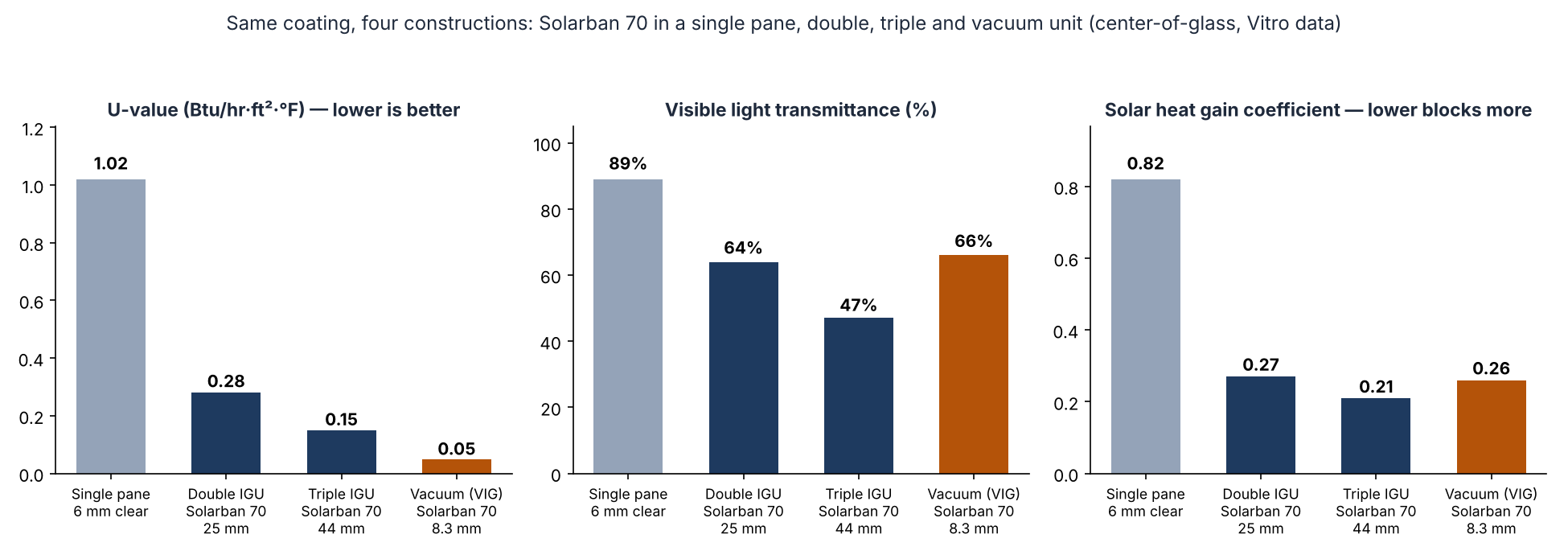
In short: If the frame is sound, replacing the glass gets you most of what a new window would, for a fraction of the cost and a morning of disruption per opening. The gains are measurable. On energy: a single 1/4-inch clear pane has a center-of-glass U-value of about 1.02; a clear double-glazed unit about 0.45; the same unit with a low-E coating and argon about 0.24, with solar heat gain cut from 0.82 to between 0.39 and 0.27 depending on the coating. On sound: a single pane rates around STC 31; a standard double unit only a few points better; a double unit with a laminated inner lite reaches the high 30s, which is the difference between hearing the bus and not. Both upgrades go into the frame you already have. What follows is what each one is worth, when it is worth it, and the cases where the glass is not the problem. The service itself is described on our glass replacement page.
A window is a frame and a glazed unit, and on most windows the glass is 75 to 90 percent of the area. The frame matters, a thermally broken aluminum or a wood frame insulates far better than an old non-thermal aluminum one, but the glass is where the heat, the sun and the noise mostly pass. That is why a glass upgrade in a decent frame moves the numbers so far, and why a new window with the wrong glass can disappoint.
The cost side is the other half of the argument. A replacement unit is priced per lite and installed from inside in most frames, with no permit, no exterior work, no interior trim disturbed and no Landmarks filing. A full replacement is priced per opening, needs a permit in most of New York City, and takes weeks of lead time. On a building with sound frames, the glass-only route is usually a third to a half of the cost of new windows, with the glass performance identical. The frame questions that decide between the two are covered in how we decide between glass-only and full replacement.
| Glass in the frame | U-value (center of glass) | Solar heat gain (SHGC) | What it means |
|---|---|---|---|
| Single 1/4-inch clear | 1.02 | 0.82 | Loses heat fastest; cold surface, condensation in winter; most of the sun's heat comes in |
| Clear double unit, 1 inch, air | 0.45 | 0.70 | Halves the heat loss; still lets most solar heat in |
| Low-E double unit, argon (Solarban 60) | 0.24 | 0.39 | Half the loss of clear double glazing; 60 percent of the solar heat kept out |
| Low-E double unit, argon (Solarban 70) | 0.24 | 0.27 | Same insulation, more shading; for south and west glass |
| Low-E double with second coating on surface #4 | 0.19 | 0.27 | For buildings chasing an energy target without going to triple |
| Low-E triple unit | 0.15 | 0.21 | Best insulation, 1 3/4 inches thick; needs a frame that takes it |
Read the table as two separate benefits. The U-value is winter: a unit at 0.24 loses less than a quarter of the heat of a single pane through the same area, and because the inside surface stays warmer the window stops condensing and the room next to it stops feeling cold. The SHGC is summer: a Solarban 70 unit keeps out nearly three quarters of the solar heat that a single pane lets through, which is what shows up on the cooling bill in a west-facing apartment. Which coating to choose, and what the data sheet columns mean, is in same low-E glass, different numbers; the product itself is on the low-E glass page.
Two practical notes. The frame sets the thickness the pocket will take; most aluminum and wood windows accept a 1/2-inch to 1-inch unit, and where only a 1/4-inch rabbet exists, a thin unit or vacuum glass is the option. And for a commercial building, a glass upgrade across a facade is one of the measures that move the building energy grade and the Local Law 97 position without a facade project; see property energy performance.
Owners expect new double glazing to be quiet and are surprised when the bus is still there. The reason is that two panes of the same thickness with a narrow air space resonate together; the mass has doubled, but the construction does little more than a single pane at traffic frequencies. The numbers from the same Vitro comparison make the point:
| Glass | STC (voices, general) | OITC (traffic, aircraft) | What you hear |
|---|---|---|---|
| Single 1/4-inch clear | 32 | 29 | Street conversation, every bus and horn |
| Double unit, 1/4 + 1/2 air + 1/4 | 34 | 29 | Slightly muted; traffic rumble unchanged |
| Double unit with laminated inner lite (1/4 laminated + 1/2 + 1/4) | about 37 to 39 | about 32 to 33 | Traffic becomes background; voices on the street no longer intelligible |
| Double unit, asymmetric lites (3/8 laminated + 1/2 + 1/4) | about 40 | about 34 | For avenue, elevated train and flight-path exposures |
| Triple unit, low-E | 40 | 32 | Good for high frequencies; a laminated lite still does more for low rumble |
| Secondary interior window, 3 to 4 inch air space | 45 and above | 40 and above | Landmark and extreme cases; see below |
The laminated interlayer is what changes the result. The soft PVB or acoustic PVB layer between two pieces of glass damps the vibration instead of passing it on, and making the two lites different thicknesses stops them resonating at the same frequency. Every three points of STC is a noticeable reduction; ten points sounds like half as loud. A laminated inner lite also gives you safety glazing and a lite that stays in the frame if it breaks, which is why we specify it on ground floors anyway. See acoustic glass, laminated glass and laminated vs triple for soundproofing.
Where a window faces an elevated train or a highway, or where the frame cannot be touched (a landmark church, a pre-war building with original steel sash), the next step is a secondary interior window with a deep air space, as on 1763 Amsterdam Avenue, where two lites of 1/2-inch laminated glass with a 3-inch air space quieted a church sanctuary on a bus route. That is the ceiling of what glass can do; soundproof windows covers the options in order.

In each of those cases we say so at the survey and quote the window replacement instead. In every other case, the glass is the better first move.
A photo of the window from inside and a photo of the problem (fog, crack, condensation, the view onto the avenue), the approximate size, the number of lites, and what you want from the new glass: energy, noise, safety or all three. We check the frame, confirm the thickness the pocket takes, and quote a match and an upgrade side by side. request a quote or read the glass replacement service page.
For energy and sound, nearly: the glass carries 75 to 90 percent of a window's performance. If the frame is sound and takes the right unit, the glass-only route gives the same glass performance at a third to a half of the cost, from inside, without a permit.
A single clear pane has a center-of-glass U-value of about 1.02; a low-E argon double unit about 0.24, with solar heat gain cut from 0.82 to 0.27 to 0.39 depending on the coating. That is roughly a quarter of the heat loss and up to two thirds less solar heat.
Only a little by itself: two equal panes with a narrow air space rate about STC 34 against 32 for a single pane. A laminated inner lite takes a double unit to the high 30s, which is the change people hear.
STC rates mid and high frequencies, such as voices; OITC rates the low-frequency rumble of traffic and aircraft. For a window on an avenue, OITC is the number that matters, and laminated glass improves it more than extra thickness does.
If the frame's glazing pocket is deep enough for a 1/2-inch to 1-inch unit, yes. Where it is not, a thin unit or vacuum glass may fit, or the sash is replaced.
Usually. A low-E unit keeps the inside surface warm and a warm-edge spacer keeps the edge warm, so the glass stays above the dew point on most winter days.
Yes. A low-E upgrade across a facade lowers heating and cooling load without a facade project, and it counts in the building's energy performance.
When the frame leaks, is rotten or corroded, is out of square, is non-thermal aluminum in a cold room, cannot take the unit the room needs, or the opening itself has to change.
Glass replacement service Low-E glass Acoustic glass Insulated glass units Soundproof windows NYC Same low-E glass, different numbers Glass-only vs full replacement
About this page. Written by Alex GC Inc. d/b/a Alex Glass Construction and reviewed before publication by Aleksandr Chernovolenko, Managing Partner, with our design and estimating lead and a field foreman. Our foremen hold the NYC DOB Site Safety Training supervisor card and our crews the 40-hour worker card; we are certified to fabricate, install and service Alutech and Everest aluminum systems. Facts are drawn from our own projects, manufacturer test data and the applicable codes; where we are giving an opinion, we say so. Last reviewed November 2026. Credentials
Send a photo of the window and the problem, the size and the count. We quote a match and a low-E or laminated upgrade side by side and install in the frame you have.