How each material is made into a curve, what it can and cannot do, and how to choose for your building.
An arched window can be made in any of the common frame materials: aluminum, wood, or plastic (uPVC, usually called vinyl in the United States). What changes from one to the next is how the curve is produced, how tight and how large the arch can be, whether the curved part can open, and what it costs. This article goes through each material, explains how a straight length of frame becomes an arch, and answers the question we are asked most: which material is most commonly used for arch windows.
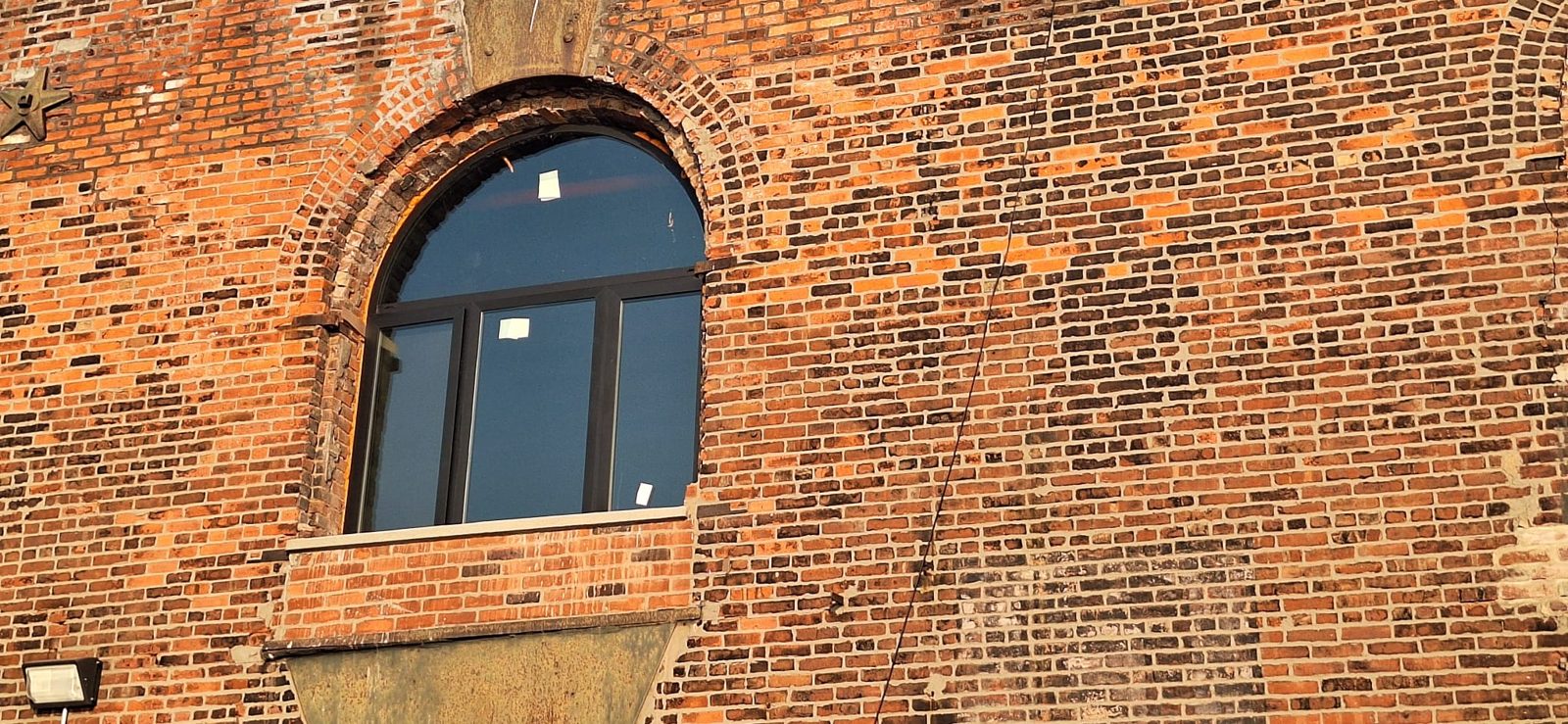
It depends on the kind of building.
In our own work around New York the split is roughly aluminum and clad wood, with uPVC used on rental buildings. The right choice follows the building, not a ranking.
A window frame starts as a straight length: an aluminum extrusion, a uPVC extrusion, or a piece of timber. There are three ways to turn it into a curve, and each material favors one.
Every method has a minimum radius: the tightest curve the profile can take before it buckles, cracks or distorts. Deep, complex profiles need a larger radius than shallow, simple ones. That is why a small, tight arch is sometimes easy in wood and impossible in a heavy aluminum system, and why the supplier needs the real dimensions before promising anything.
Aluminum arches are made by bending the extruded profile on rollers or by stretch-forming it around a die. With thermally broken systems, the inner and outer halves and the insulating strips between them all have to follow the same curve, so the bending is specialist work and each system has published limits. After bending, the frame is finished, usually powder coated, and glazed with an insulated glass unit cut to the same template.
Examples from our portfolio: 185 Van Dyke Street, where each arch was templated individually; Ocean Parkway at Avenue W, with slim-profile arched windows in limestone surrounds; and Somerset, NJ, with four arched gable windows. See aluminum windows.
Wood has been made into arches for as long as there have been arched windows. Today the curved members are either laminated from thin strips glued around a form, or cut by CNC from built-up blanks and joined. Because wood is shaped by cutting as well as bending, it can follow almost any curve: full half-rounds, flat segmental arches, ellipses, Gothic points and true matches to an existing historic sash.
Most new wood windows are clad: wood inside, with an aluminum or fiberglass skin outside so the exterior never needs painting. On curved units the cladding is formed to match. Manufacturers such as Pella and Marvin offer arched and custom-radius units as part of their standard lines.
Examples: 343 Hoyt Street, Carroll Gardens, Pella windows in arched brick openings in a historic district. See Pella and Marvin.
"Plastic", "uPVC", "PVC" and "vinyl" all describe the same material in a window: rigid, unplasticized polyvinyl chloride. To make an arch, the straight hollow profile is heated until it softens, bent around a form of the required radius, and held there while it cools. The corners are then welded as on any uPVC window.
Two things limit what can be done. The hollow chambers that make uPVC a good insulator can collapse or wrinkle if the curve is too tight, so each profile has a minimum radius. And the steel reinforcement that stiffens a straight uPVC frame has to be curved to match, or left out, which limits the size of the arch.
See uPVC windows.
Steel makes the slimmest arched windows of all, with fine curved glazing bars, and is the traditional material of old factory and studio windows. Modern thermally broken steel is beautiful and expensive. Fiberglass frames are strong and stable, but the pultruded profiles cannot be bent after manufacture, so curved fiberglass units are limited and less common.
| Aluminum | Wood / clad wood | uPVC (vinyl) | |
|---|---|---|---|
| How the curve is made | Roll- or stretch-bent | Laminated or CNC-cut | Heated and bent |
| Largest arches | Best | Good | Limited |
| Tight radii and odd shapes | System-dependent | Best | Limited |
| Frame thickness | Slimmest | Medium | Thickest |
| Colors | Any | Any outside; wood inside | Limited |
| Historic districts | Sometimes | Usually accepted | Rarely |
| Relative cost | High | High | Lowest |
| Maintenance | Very low | Low if clad | Very low |
Usually it does not, in any material. The common arrangement is a fixed arched lite above a rectangular window that opens, with a horizontal bar where the two meet. This keeps the hardware simple and the seal reliable. Operable curved sashes exist, such as arched-top casements and tilt-and-turn windows with a curved head, but they cost more, have tighter size limits and are offered in fewer systems. If ventilation matters, plan for it in the rectangular part. See arched windows for configurations.
Whatever the frame, the glass is an insulated unit cut to the shape of the arch, with the spacer bar bent to follow the curve. Shaped units can be tempered or laminated like rectangular ones, and take the same low-E coatings. The glass is flat; only the outline is curved. Truly curved (bent) glass is a different and much more expensive product, used when the window itself bows in plan.
Lead time is longer for an arched unit than for a rectangular one in every material, because the curve is made to order. Decide early.
In ordinary houses, vinyl (uPVC), because it is the most common residential window material and bends easily. On historic and traditional buildings it is wood or clad wood, and on large, modern or commercial openings it is aluminum.
Yes. The extruded profiles are roll-bent or stretch-formed to the required radius, then finished and glazed. Each system has a minimum radius.
Yes. The profile is heated, bent around a form and cooled. Size and radius are more limited than in aluminum or wood.
Neither is better in general. Wood suits traditional and historic buildings and can follow almost any shape; aluminum suits large openings, slim frames and modern or industrial buildings.
The arched part is usually fixed, with an operable rectangular window below it. Operable arched sashes exist in some systems but are more limited and more expensive.
No. It is flat insulated glass cut to an arched outline. Bent glass is a separate, more expensive product.
Arched Windows Shaped Windows Aluminum Windows uPVC Windows Pella Marvin All News
About this page. Written by Alex GC Inc. d/b/a Alex Glass Construction and reviewed before publication by Aleksandr Chernovolenko, Managing Partner, with our design and estimating lead and a field foreman. Our foremen hold the NYC DOB Site Safety Training supervisor card and our crews the 40-hour worker card; we are certified to fabricate, install and service Alutech and Everest aluminum systems. Facts are drawn from our own projects, manufacturer test data and the applicable codes; where we are giving an opinion, we say so. Last reviewed September 2026. Credentials
Send a photograph of the opening with the width and the height to the top of the arch. We will tell you which material suits it and quote it.