The four Marvin lines differ in what faces the weather, what faces the room, how custom the unit can be and what the Landmarks Commission will accept. Here is how we choose between them on a townhouse, a co-op and a new house, and why the answer is usually two lines.
In short: Marvin sells four lines. Signature Ultimate is wood inside with extruded aluminum cladding outside, built to order in almost any size, shape, species and color: the line for a landmarked townhouse or a house where the detailing is the point. Signature Modern is a different product for a different house: high-density fiberglass frames, narrow sightlines, very large glass. Elevate is Marvin’s Ultrex fiberglass outside with a wood interior, the sensible middle for most high-end replacement work. Essential is Ultrex inside and out, with nothing to finish or maintain, and it is what we put on the rear, the side and the basement so the budget goes to the front. For a New York house the usual answer is two lines, not one.
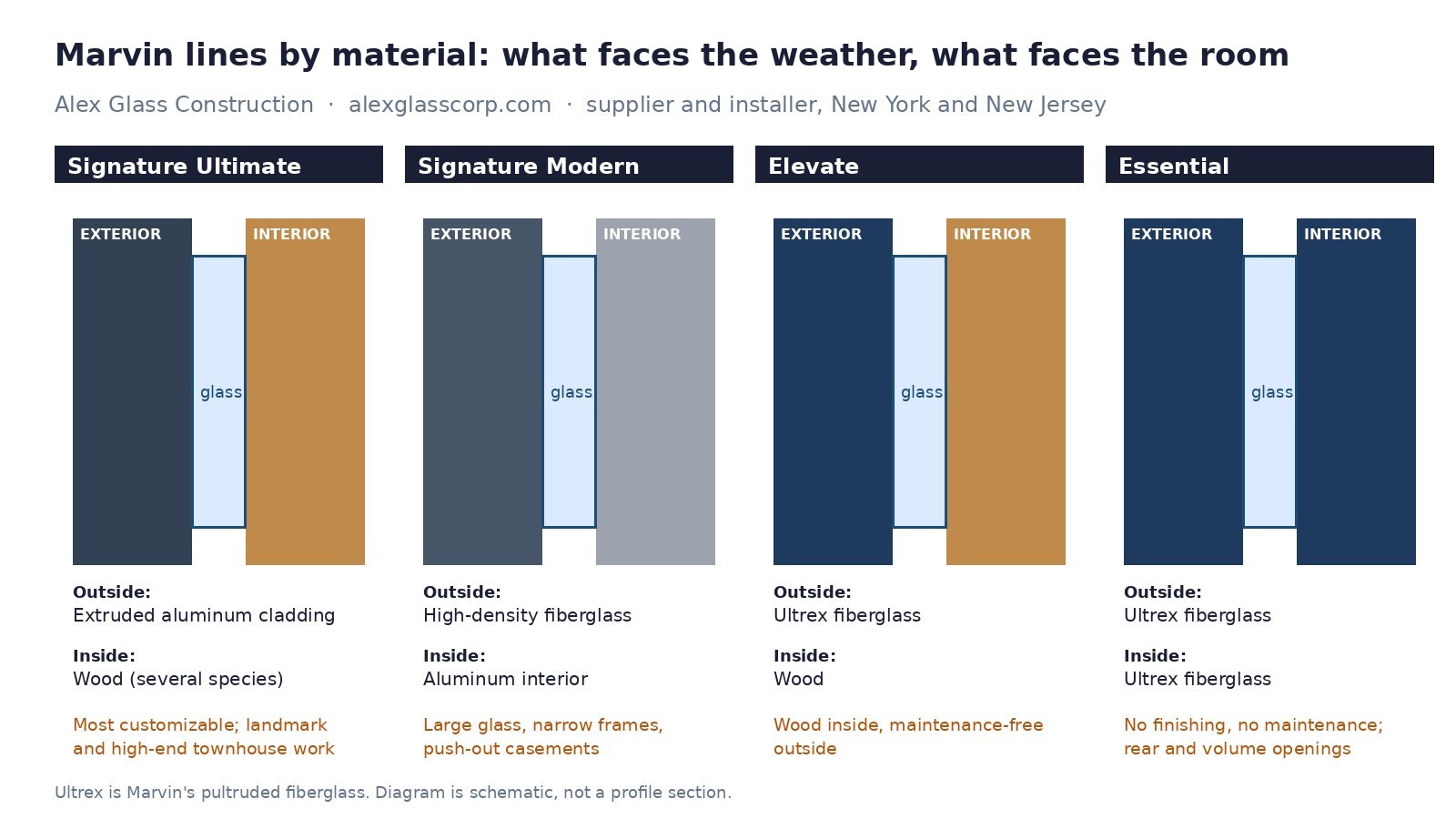
Clients call us about “Marvin windows” as if that settled the specification. It does not. The same double-hung opening on a Brooklyn brownstone can be filled with an Essential unit, an Elevate unit or a Signature Ultimate unit, and the three differ in material, in how they look up close, in what the Landmarks Preservation Commission will say about them, and in price by a wide margin. Marvin organizes its range by material combination and degree of customization rather than by a good-better-best ladder, and that is the right way to think about it: ask what should face the weather, what should face the room, and how custom the opening is.
Marvin is a family-owned American manufacturer, in Warroad, Minnesota since 1912, and everything is built to order. Its distinguishing material is Ultrex, a pultruded fiberglass: glass fibers pulled through resin and a heated die so the fibers run the length of the section. Ultrex expands and contracts at close to the rate of glass, which is why Marvin frames stay tight to their sealed units through New York winters where a vinyl frame works against the glass. Where Marvin does use wood, it is wood you see and touch on the inside, protected on the outside by aluminum or fiberglass. We are a supplier and installer of Marvin across the city, Long Island and New Jersey; the brand page is Marvin windows and doors in New York.
| Line | Outside | Inside | Customization | Best for in New York |
|---|---|---|---|---|
| Signature Ultimate | Extruded aluminum cladding, wide color palette, custom colors | Wood: pine, Douglas fir, mahogany, white oak, black walnut and others; bare, primed or finished | Highest: custom sizes, shapes, radius, authentic and simulated divided lites | Landmarked townhouses and brownstones; high-end houses; restoration |
| Signature Modern | High-density fiberglass | Aluminum interior | High within a contemporary vocabulary: large direct-glazed units, multi-slide doors, push-out casements | Contemporary houses and additions; architects who want narrow frames and big glass |
| Elevate | Ultrex fiberglass | Wood: pine, bare, primed or finished | Moderate: standard and custom sizes, simulated divided lites | Most high-end replacement; houses that want wood inside and no exterior maintenance |
| Essential | Ultrex fiberglass | Ultrex fiberglass | Streamlined option list, standard and custom sizes, grilles between the glass or simulated divided lites | Rear and side elevations, basements, rentals, volume work; coastal exposure |
Ultimate and Elevate look alike from the street when they are specified in the same color and divided-lite pattern. Up close the difference is the exterior cladding: extruded aluminum on Ultimate, with sharper profiles and a deeper color range, against the fiberglass of Elevate. Inside, Ultimate offers the full range of species and a factory finish; Elevate is pine, usually factory-finished. Essential is recognizable by its clean, slightly plainer frame, which is exactly right where nobody is looking closely.
In a New York historic district the Landmarks Preservation Commission reviews what is seen from the street: the profile of the frame and the meeting rail, the sightlines, the divided-lite pattern and the color. Signature Ultimate is the line that is approved regularly on those blocks, because it can be built to the proportions of the original window with authentic divided lites (individual panes between real muntins) or simulated divided lites (permanent bars inside and out with a spacer bar aligned between the panes, so there is a true shadow line). Grilles between the glass, which are flat from outside, are not usually accepted on a primary facade.
The rebuilt townhouse on East 71st Street on the Upper East Side is the example: Marvin Ultimate wood double-hungs on the street rooms, Low-E3 argon glass at a U-factor of 0.28, while the rear, which the Commission does not see, carries black aluminum door walls to the terraces. 126 Washington Avenue in Clinton Hill is a rebuilt brick front with Marvin double-hungs under an arched aluminum dormer. How the filing works is on landmark window replacement.
A pre-war co-op has a window standard: a line, a color and a configuration the board has approved for the building, and an alteration agreement that says how the work is done. Where the standard allows Marvin, it is usually Ultimate or Elevate double-hungs in the building’s color, and the choice between them is interior: a wood species and finish the owner wants to see (Ultimate) or a factory-finished pine interior at a lower price (Elevate). The board wants drawings, the installer’s insurance and a schedule; we prepare all three.
Here the architect usually decides. A traditional house with divided-lite casements, double-hungs and French doors in black or bronze is Signature Ultimate or Elevate, and the two are often mixed: Ultimate on the front and the main rooms, Elevate elsewhere. A contemporary house with floor-to-ceiling fixed glass, multi-slide doors and the thinnest possible frames is Signature Modern, which exists for exactly that and offers push-out casements without a crank. Where an architect has drawn very large aluminum sliding walls or tilt-and-turn operation, a European aluminum system such as Reynaers or Cortizo may be the better fit, and we quote it alongside; see wood and clad-wood windows for where each belongs.
Essential is Ultrex fiberglass inside and out: no wood, no finishing, nothing to paint or seal. The option list is shorter, which is what makes it cheaper and faster, and the frame is as stable as any Marvin makes. We specify it on the openings the owner never looks at closely and the Commission never sees: rear elevations, side walls, basements, laundry rooms, utility spaces, and rental units. It is also the right answer within reach of salt air on Long Island and at the Jersey Shore, with laminated glass and stainless hardware, because there is no cladding joint and no wood to protect.
The saving is real. A whole-house package of twenty openings quoted entirely in Ultimate and the same package quoted Ultimate on the eight street-facing openings and Essential on the twelve others are far apart in price, and the two houses are indistinguishable from the sidewalk. We would rather help a client spend the budget where it shows.
All four lines take Marvin’s insulated glass with Low-E coatings chosen for the New York climate, argon fill, and laminated or tempered glass where sound, security or code calls for it; triple glazing is available where the energy target demands it. Divided lites are where the lines separate: authentic divided lites on Ultimate only; simulated divided lites with a spacer bar on Ultimate, Elevate and Essential; grilles between the glass on Elevate and Essential. Hardware finishes and the interior finish palette are widest on Ultimate. Screens, including retractable screens on casements and doors, are available across the range.
Marvin does not publish prices and the same opening can be quoted in Essential, Elevate or Ultimate at prices far apart, so a single number would mislead. The order of cost is Essential, then Elevate, then Signature Ultimate and Modern, and within a line the size, a custom shape, the divided-lite type, the interior finish, a custom exterior color and the glass make-up each move the number. On top of the units sit the installation conditions: a sidewalk shed or scaffold on a townhouse front, the Landmarks filing, and removing the existing frames. We quote per opening with the line, glass, grilles, finish and hardware named, and usually price a second line alongside so you can see what each step up buys. Lead times run roughly six to twelve weeks by line and finish, longer for custom shapes and colors.
Area pages: Marvin in Manhattan, Marvin in Brooklyn, Marvin on Long Island, Marvin in New Jersey. For how Marvin compares with the other two American wood-window brands we carry, see Pella vs Andersen vs Marvin.
Signature Ultimate is wood inside with extruded aluminum cladding outside and is the most customizable; Elevate is Ultrex fiberglass outside with a wood interior; Essential is Ultrex fiberglass inside and out with a shorter option list. Signature Modern is a fourth line for contemporary houses: fiberglass frames, narrow sightlines and large glass.
Signature Ultimate, with authentic or simulated divided lites in the pattern the Landmarks Preservation Commission approves. It can be built to the proportions of the original window, which is what the Commission reviews.
On the rear and side elevations, yes, and on the front where the house is not landmarked and the owner is content with a pine interior. On a landmarked front, Signature Ultimate is the safer filing.
Yes, and we recommend it: Ultimate or Elevate on the street-facing openings, Essential on the rear, side and utility openings. The lines share styling closely enough that the difference is invisible from the street, and the saving on a whole-house package is substantial.
Marvin’s pultruded fiberglass: glass fibers pulled through resin and a heated die so they run the length of the section. It expands and contracts at close to the rate of glass, does not rot, warp or chalk, and takes a factory finish.
Each is better at something. Marvin leads on custom sizes and shapes, wood interiors and large contemporary glass in the Modern line; Pella on integrated features such as blinds between the glass; Andersen on value in the 400 Series. We carry all three and quote the one that fits.
It depends on the line, size, divided lites, finish, glass and installation conditions; Essential costs least and Signature Ultimate and Modern the most. We quote per opening with everything named, usually with a second line alongside, and the quote is free.
Alex Glass Construction supplies and installs Marvin across Manhattan, Brooklyn, Queens, the Bronx, Staten Island, Long Island and New Jersey, with the Landmarks, co-op or town filing prepared by us. Call 929-235-1233.
Marvin windows and doors in New York Marvin in Manhattan Marvin in Brooklyn Wood and clad-wood windows Landmark window replacement Pella windows and doors Andersen windows and doors Request a quote
About this page. Written by Alex GC Inc. d/b/a Alex Glass Construction and reviewed before publication by Aleksandr Chernovolenko, Managing Partner, with our design and estimating lead and a field foreman. Our foremen hold the NYC DOB Site Safety Training supervisor card and our crews the 40-hour worker card; we are certified to fabricate, install and service Alutech and Everest aluminum systems. Facts are drawn from our own projects, manufacturer test data and the applicable codes; where we are giving an opinion, we say so. Last reviewed September 2026. Credentials
Send photos of the openings and tell us the building. We will quote the line that fits, with a second line alongside, and handle the Landmarks or board filing.